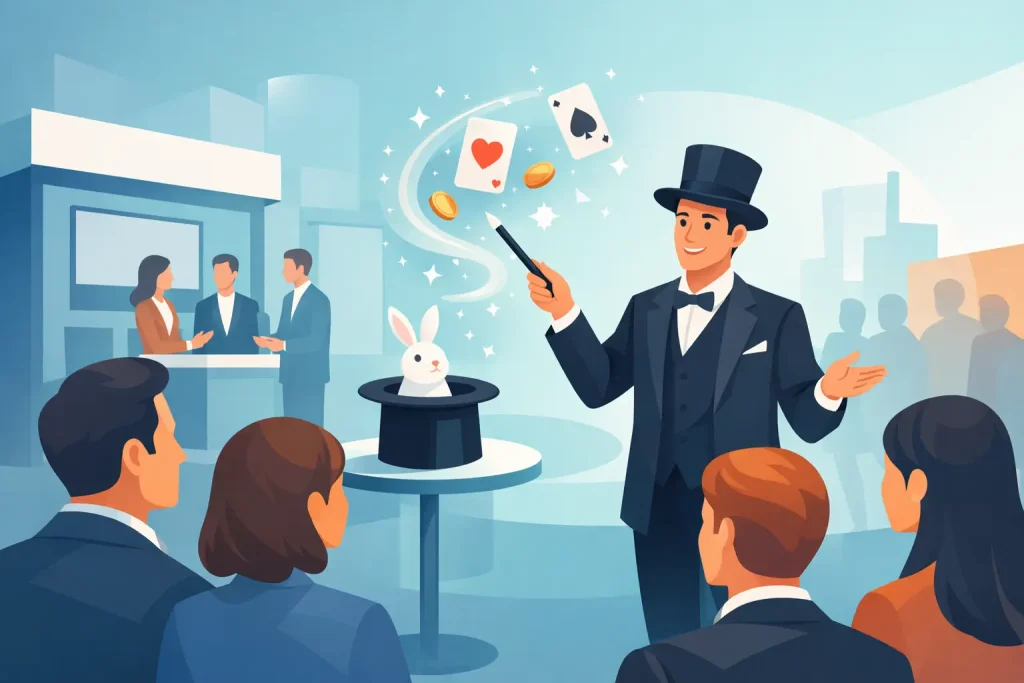
The difference between a busy booth and an ignored booth is rarely the booth itself. Plenty of companies show up with sharp graphics, polished giveaways, and a good-looking space, then wonder why attendees keep walking. A trade show magician changes that dynamic fast by doing what static displays cannot – stopping traffic, starting conversations, and turning passive foot traffic into real engagement.
That matters because trade shows are expensive. Floor space, travel, booth design, staffing, shipping, and sponsorships add up quickly. If your team is investing that much to be there, you need more than visibility. You need attention, interaction, and a reason for people to remember your company after the show floor closes.
What a trade show magician actually does
Some buyers hear the phrase and picture a few card tricks off to the side. That is not the model that gets results. A strong trade show magician is not hired just to entertain people while your sales team waits nearby. The performance is built to support the booth’s objective.
That objective might be attracting a larger crowd. It might be delivering a product message in a way people actually watch. It might be qualifying prospects before they ever reach a salesperson. In many cases, it is all three.
The right performer becomes part of your booth strategy. He gathers people, keeps them engaged long enough to communicate your core message, and gives your team a better opening to start sales conversations. Instead of asking attendees to stop and listen, you create a moment they want to join.
Why this works on a crowded show floor
Trade shows are a battle for attention. Every exhibitor wants the same thing at the same time – eyeballs, conversations, and qualified leads. Attendees are moving quickly, making snap judgments, and filtering out anything that feels generic.
A live performance cuts through that noise because people are wired to notice activity. When a small crowd forms, others slow down to see what is happening. That social proof is powerful. A booth that looks active feels worth checking out. A booth with no audience often gets passed by, even if the product is excellent.
That is the first advantage. The second is retention. Most trade show messaging is forgettable because it sounds like every other pitch in the aisle. When key points are woven into a live, interactive presentation, attendees are more likely to remember both the message and the brand behind it.
There is also a practical sales advantage. A magician who knows the trade show environment can pre-frame the interaction, identify interested prospects, and direct the right people to your team. That makes the handoff smoother and warmer than asking reps to cold-start every conversation.
A trade show magician is not just about crowd size
Crowd size looks good, but traffic alone is not the goal. If the booth is packed with people who have no buying authority, no use for your product, or no interest in your service, the activity may feel exciting without helping your results.
That is why customization matters. A business-focused trade show magician shapes the presentation around who you want to attract and what you need them to understand. Sometimes that means a shorter, faster set designed for high-volume foot traffic. Other times it means a more targeted presentation that intentionally filters for better prospects.
This is where many entertainment vendors miss the mark. They can be funny. They can be skillful. But if they cannot connect the performance to your business goal, they are adding energy without necessarily adding value.
A strategic trade show presentation should answer a few basic questions. What message needs to stick? Who is the ideal attendee? What action should happen next? If those answers are clear, the performance can become a real sales support tool rather than a distraction.
How branded magic presentations drive better conversations
The strongest booth presentations do more than gather people. They make your company easier to understand.
That can happen in a few ways. Product benefits can be tied into key moments of the routine. A company tagline can be repeated in a way that feels natural instead of scripted. A differentiator your team has said a thousand times can suddenly feel fresh because it lands inside a memorable live demonstration.
This is one reason exhibitors often see better follow-up after a well-executed trade show performance. People may not remember every detail from the convention hall, but they remember the booth where something interesting happened and the company connected that experience to a clear message.
If your sales process depends on familiarity and recall, that is a big advantage. Buyers rarely act based on one interaction alone. They act when they remember you, understand what you do, and have a reason to reply when your team follows up.
When hiring a trade show magician makes the most sense
This approach tends to work best when your team has a real objective beyond simply showing up. If you need to increase booth traffic, launch a new product, stand out in a competitive category, or give your reps more qualified conversations, it can be a smart fit.
It is also useful when your product is complex. Some offerings need more than a brochure and a smile. They need a compelling way to get attendees to pause long enough to hear the value proposition. A live presentation buys you that time.
That said, it is not automatically the right choice for every booth. If your space is too small for a crowd, if show rules severely limit live presentations, or if your team is not prepared to capture and work the leads generated, the impact may be reduced. A performer can create momentum, but your booth system still needs to support that momentum.
What event planners and marketing teams should look for
If you are considering this for an upcoming show, the first thing to evaluate is business fluency. Can the performer speak the language of trade show ROI, lead generation, booth flow, and buyer attention span? That matters more than having the flashiest tricks.
You also want someone who can adapt. Trade show floors are unpredictable. Aisles get blocked. Audio competes. Crowd size changes by the hour. The best performers can read the room, adjust pacing, and keep the presentation effective under real event conditions.
Professionalism is non-negotiable. Corporate buyers need talent who shows up prepared, works well with exhibit staff, understands schedules, and makes the client look good. That reliability is part of the service.
And yes, customization should be part of the conversation. If the act could be dropped into any booth with no change at all, it is probably not built to support your goals. The more the presentation reflects your brand, your message, and your audience, the stronger the outcome tends to be.
The sales team factor
One overlooked piece of the equation is what happens after the crowd gathers. The booth team has to be ready.
When the performance ends or transitions, attendees should know where to go next. Reps should know how to continue the conversation without killing the momentum. Lead capture should be simple. Messaging should match what the audience just saw.
This is why the best results come from alignment. A trade show magician can create the opening, but the sales team needs to close the gap between interest and action. When those pieces work together, the booth feels coordinated instead of chaotic.
That is also why many companies bring in specialists who understand both performance and event strategy. Someone like Mike Seege is not there to compete with the booth staff for attention. He is there to help the staff get more of the right attention.
The real value is momentum
At a trade show, momentum changes everything. It affects how many people stop, how long they stay, how your brand is perceived, and how many worthwhile conversations your team gets to have. A well-positioned live performer creates that momentum in a way signs and screens usually cannot.
And unlike novelty attractions that pull a crowd without direction, a business-minded presentation can move people toward a specific message and a specific next step. That is the difference between entertainment that looks busy and entertainment that helps the booth perform.
If your next event needs more than polite traffic and forgettable interactions, a trade show magician is worth considering – not as a gimmick, but as a practical way to create attention, improve recall, and give your team a stronger shot at turning the show floor into actual opportunity.
The smartest event decisions are the ones that make your audience lean in and make your sales team’s job easier at the same time.