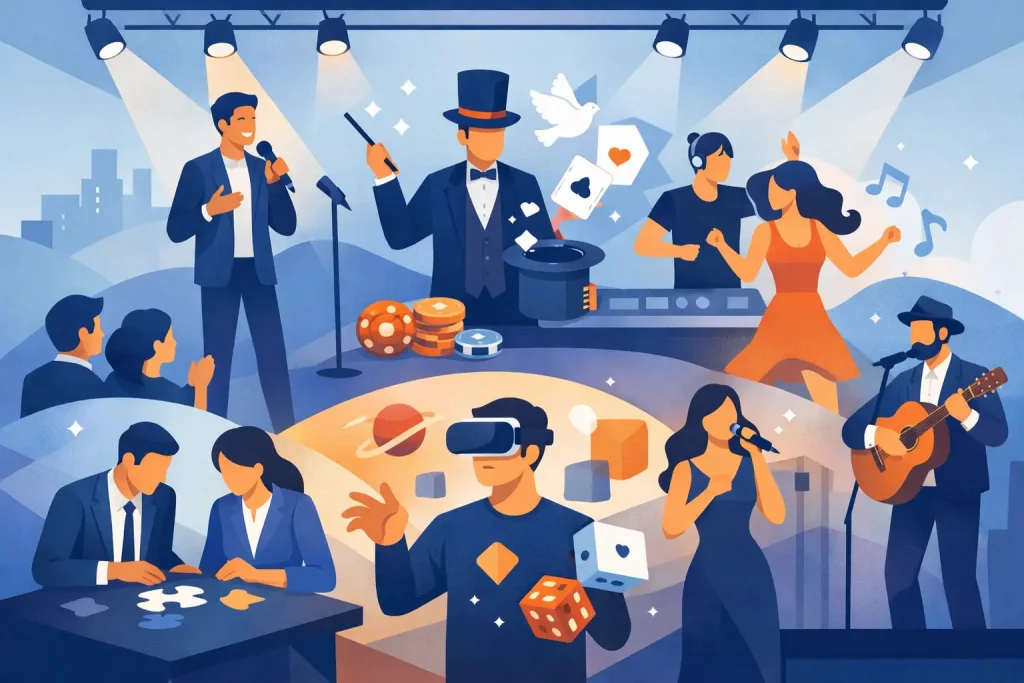
The fastest way to lose a conference room is to give people another hour of passive content when their attention is already running on coffee fumes. Great conference entertainment ideas do more than fill a break or check a box on the agenda. They reset energy, create talking points, support your brand, and give attendees a reason to remember your event after the badges come off.
That matters because conference entertainment is rarely judged as entertainment alone. Event planners are judged on turnout, engagement, pacing, guest feedback, sponsor value, and whether the day felt worth the budget. The right act or experience helps on all of those fronts. The wrong one becomes background noise.
What makes conference entertainment ideas actually work?
The best choices are interactive, easy to understand, and appropriate for the room. A conference general session needs something different than a networking reception. A sales kickoff can handle higher energy than a compliance-heavy leadership meeting. And if your event has sponsors, exhibitors, or a specific message to reinforce, entertainment should support that goal instead of competing with it.
That is the real test. Not just, Was it fun? Ask, Did it hold attention? Did it fit the audience? Did it help people connect? Did it make the brand more memorable? If the answer is yes, you did not book a distraction. You booked a business asset.
11 conference entertainment ideas worth considering
1. Interactive corporate magic
This is one of the strongest options when you need people fully engaged, not half-watching from the back of the room. Interactive magic works because it creates surprise, conversation, and participation in real time. It can play big on stage for a keynote-style moment, or move through a reception as strolling entertainment that keeps clusters of guests energized.
For planners, the upside is flexibility. It can fit an opening session, awards dinner, cocktail hour, hospitality suite, or sponsor activation. It also gives you an advantage that many acts do not – messaging can be woven into the performance. When done well, your audience is not just entertained. They are reacting, laughing, talking, and remembering the company that brought the experience to life.
2. A professional emcee who is also an entertainer
Some conferences do not need another act. They need a stronger thread tying the day together. A skilled emcee with real stage presence keeps sessions moving, fills dead air, lifts energy after lunch, and makes transitions feel intentional instead of awkward.
This is especially valuable for events with multiple speakers, sponsor mentions, panel handoffs, and changing room energy. A polished emcee can add humor, audience interaction, and momentum without derailing timing. If your biggest risk is a flat room or a clunky schedule, this may outperform a stand-alone entertainment segment.
3. Strolling entertainment during receptions
Networking receptions often sound better on paper than they feel in the room. Guests check their phones, stand with coworkers, and wait for someone else to start the conversation. Strolling entertainment changes that dynamic fast.
Close-up performance in small groups gives people an instant shared experience. It breaks social friction, creates natural openings for conversation, and keeps the room from feeling static. For planners, it is one of the easiest ways to make a reception feel active without adding a complicated production footprint.
4. Customized trade show floor entertainment
If your conference includes an expo hall, this category deserves its own strategy. Booth traffic does not increase because a company bought a banner and hoped for the best. It increases when people see a crowd, hear laughter, and notice active engagement.
Entertainment tailored for trade shows can stop traffic, gather prospects, and deliver key talking points in a way attendees actually absorb. That matters when exhibitors are measuring ROI and sales teams want more than badge scans. The strongest conference entertainment ideas for expo settings are not passive at all. They pull people in, qualify interest, and help reps start warmer conversations.
5. Audience game segments between sessions
Short, high-energy games can be excellent if your event needs a reset. Think of them as strategic energy management, not filler. A five-minute interactive segment between dense presentations can bring a room back to life better than another coffee station.
The trade-off is tone. If your audience is highly formal or the conference topic is sensitive, games can feel forced if they lean too goofy. The sweet spot is participation that feels smart, quick, and inclusive. The goal is to wake people up, not make them cringe.
6. Clean corporate comedy
A strong comedian can be a great fit for conferences, especially at dinners, awards events, or end-of-day programs when attendees are ready to relax. Laughter builds goodwill fast, and a talented corporate comic can speak to the industry, audience type, or event context in ways that feel personal.
But this option requires more caution than some planners expect. Comedy is not automatically safe just because it is labeled corporate. You need someone who understands business audiences, keeps the material clean, and reads the room well. For broad mixed audiences, interactive entertainment often carries less risk than stand-up centered on opinion or edgy humor.
7. Team-building experiences with a live performance element
For leadership retreats, internal conferences, or culture-focused events, team-building can do double duty as entertainment and development. The best versions are interactive, fast-moving, and built around communication, problem solving, or collaboration.
This works especially well when your event is not just about information transfer. It is about getting people to connect across departments, offices, or roles. When the experience is engaging enough to feel like entertainment, participation rises. When it also reinforces workplace skills, budget approval gets easier.
8. Branded audience participation moments
Not every entertainment choice needs to be a full featured act. Sometimes what your event needs is one memorable, shared moment that belongs to your brand. That might be an interactive opener, a custom reveal, a sponsor-driven audience challenge, or a stage segment that uses company messaging in a surprising way.
This approach works best when you want memorability without overloading the agenda. It gives the room a jolt of energy and creates something attendees will talk about later. The key is execution. If branding feels pasted on, people tune out. If it is built naturally into the experience, it lands.
9. Networking activations that create conversations
A lot of conference entertainment ideas fail because they entertain people individually instead of helping them connect with each other. If networking is one of your event goals, choose activations that create shared participation.
That might mean interactive performance, hosted icebreakers, facilitated audience moments, or a roaming entertainer who can gather small groups and get them talking. This is often a smarter move than placing a novelty attraction in the corner and hoping people mingle around it. Good networking entertainment reduces social effort. That is why it works.
10. A headline closing act
When your event needs a strong finish, a featured closing performance can send people out on a high note. This is especially useful for annual meetings, association conferences, and sales events where the final impression matters almost as much as the opening one.
A closing act should feel earned and appropriately scaled to the event. If the conference has been all business, the finale can provide release. If the day has already been packed with stimulation, a quieter but highly engaging performance may work better than something loud for the sake of loud. Big energy is not always the same thing as the right energy.
11. Entertainment that supports your event message
This may be the most valuable idea on the list because it changes how you evaluate every other option. Entertainment does not have to sit outside the business purpose of the event. It can reinforce it.
When a performer can incorporate company themes, product messaging, leadership priorities, sponsor recognition, or audience takeaways, the entertainment becomes part of the event strategy. That is where buyers see the biggest return. Not just applause, but retention. Not just fun, but follow-through.
How to choose the right conference entertainment ideas
Start with the moment, not the act. Ask where your agenda is vulnerable. Is the opening cold? Is the reception stiff? Does the expo hall need traffic? Does your leadership team want a cleaner way to hold attention between speakers? Once you know the pressure point, the entertainment choice gets easier.
Then look at audience fit. Senior executives, mixed corporate groups, franchise teams, association members, and sales organizations all respond differently. A smart entertainment partner will ask about room setup, group size, schedule placement, meeting objectives, and brand tone before recommending anything.
Finally, think beyond applause. The strongest choice is usually the one that improves the attendee experience and solves a practical event problem at the same time. That is why interactive entertainment often outperforms passive acts in conference settings. It is doing more work.
Why interactive conference entertainment ideas win more often
Interactive formats tend to deliver better business value because they create visible engagement. You can feel the room change. People lean in. They talk. They laugh. They stop checking email. At trade shows, they gather. At receptions, they connect. During general sessions, they stay with you.
That is why so many planners come back to interactive magic, emceeing, and customized audience engagement. Performed well, those options are not random entertainment add-ons. They help manage energy, support messaging, and make the event feel sharper from start to finish. Mike Seege builds those experiences for exactly that reason.
If you are weighing options, the best next move is simple: choose entertainment that earns its place on the agenda. When it helps your audience engage and helps your event perform, it is no longer extra. It is one of the smartest decisions in the room.