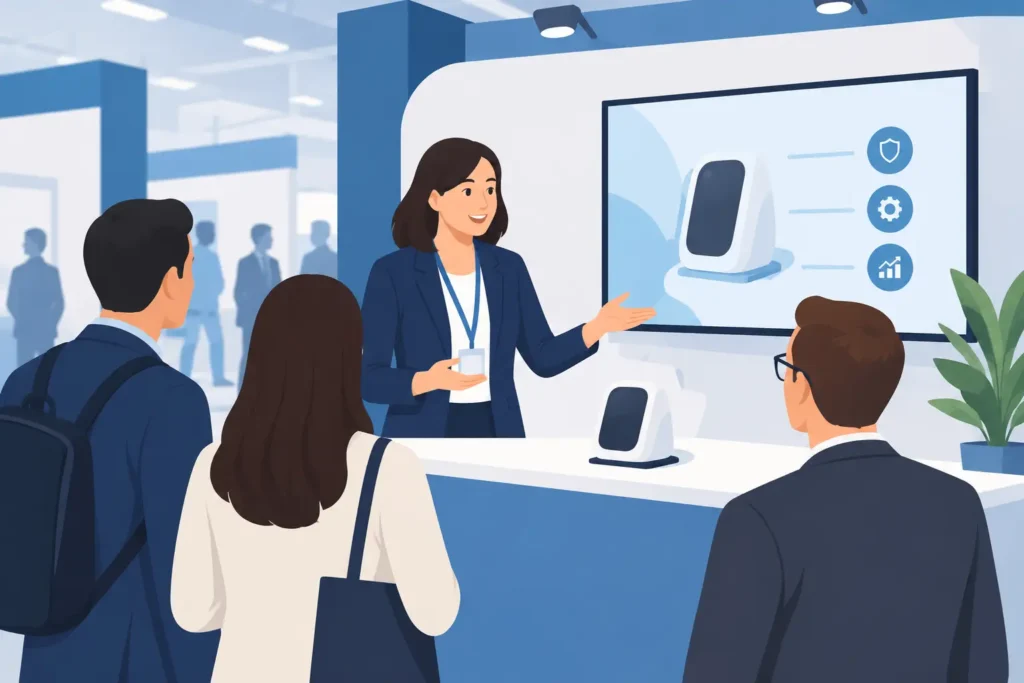
A trade show floor does not reward the booth with the best product. It rewards the booth that earns attention fast, makes its value clear, and gives attendees a reason to stop before they disappear into the next aisle. Knowing how to structure booth demonstrations turns a product explanation into a crowd-building sales tool.
The goal is not to talk longer. It is to create a repeatable live moment that attracts passersby, makes your core message memorable, and hands your sales team people who are ready to have a real conversation. That requires more than a capable presenter and a nice screen. It requires a show structure.
Start With the Outcome, Not the Product Tour
Many booth demos fail because they begin with a feature-by-feature walkthrough. The presenter knows the product inside and out, so naturally they start at the beginning. But trade show attendees are not sitting down for a training session. They are deciding, in seconds, whether your booth is worth their time.
Start by defining what the demonstration must accomplish. Is the priority to introduce an unfamiliar category, prove a bold claim, launch a new product, book meetings with enterprise buyers, or drive volume for a sales team? A demo built to gather names will look different from one built to educate technical prospects.
Choose one primary action you want attendees to take after the presentation. That could be scheduling a consultation, requesting a quote, trying the product, scanning a badge, or speaking with a specialist. If the desired next step is vague, the demonstration will be vague too.
Your audience matters just as much. A crowded consumer-facing show may reward high energy and frequent, short presentations. At an industry expo with complex buying committees, a tighter, more credible demonstration can outperform a loud spectacle. The structure should fit the room, the buyer, and the sales cycle.
How to Structure Booth Demonstrations for Attention
The strongest booth demonstrations follow a simple progression: stop, relate, reveal, prove, and direct. It is a performance framework, but it is also sales psychology. Each step answers the question an attendee is already asking.
1. Stop traffic with a visible opening
Your first 10 to 20 seconds have one job: make people pause. That does not mean shouting a slogan or launching into a company history. It means presenting an interesting problem, a surprising result, a visual moment, or a direct challenge that makes a passerby curious.
A software company might open with, “Most teams lose six hours a week to this one approval bottleneck. Let’s see if yours does.” A manufacturer might show a component surviving a stress test that competitors avoid. A branded trade show magic presentation can create that same pause with an impossible visual effect tied directly to the product message.
The opening needs to be visible beyond the people already standing in front of you. Build in movement, a large screen moment, a reveal, a physical prop, or a question people can hear from the aisle. A crowd attracts a crowd, but someone has to create the first reason to gather.
2. Name the pain your audience recognizes
Once you have attention, make attendees feel understood. Do not spend this section describing your company. Describe the costly, frustrating, or risky situation your buyer wants to avoid.
Keep this language specific. “We help businesses work smarter” says almost nothing. “We cut the back-and-forth that delays field-service approvals” gives the right person a reason to lean in.
This is where a demonstration becomes relevant instead of merely impressive. When attendees recognize their own challenge, they begin mentally connecting your solution to their operation. You have moved from entertainment to business value.
3. Reveal one clear promise
Now deliver the central idea. What does your product, service, or process make possible? State it in language a sales rep can repeat all day.
A good booth demonstration does not attempt to communicate every capability. It gives the audience one headline claim and supports it with two or three proof points. Think of it as the message they should remember while walking the show floor three hours later.
For example: “Our platform finds and resolves invoice exceptions before they delay payment.” The rest of the demo can show how it works, but the audience should never have to guess what the benefit is.
4. Prove the claim live
Proof is the heart of the demo. This is where presenters often overload the audience with screens, specifications, and optional features. Resist that temptation. Show the smallest number of steps needed to make the promised result believable.
A live product demonstration carries more weight than a polished video because it feels immediate. But live also carries risk. Internet connections fail, logins time out, and equipment behaves differently under show-floor pressure. Build a backup plan that lets the presenter continue without awkwardly waiting for technology.
Use real scenarios when possible. Show an actual workflow, before-and-after result, test, comparison, or customer outcome. If the product is too technical to demonstrate fully in three minutes, show the pivotal moment and let qualified prospects get the deeper version in a scheduled follow-up.
5. Give the audience a simple next move
Never end with “Any questions?” That puts the burden back on the attendee and drains momentum. End with a clear action that matches your objective.
You might say, “If that reporting delay is costing your team time, our specialists can map your process right here.” Or, “Scan your badge for the full benchmark and choose a demo time with the team.” The handoff should be immediate, obvious, and easy to execute.
This is the point where sales staff earn their place in the structure. They should not wait passively behind the booth counter. They should be positioned at the edges of the audience, ready to greet people as the presentation ends, identify interest, and continue the conversation.
Keep the Main Presentation Short and Repeatable
For most trade shows, a five- to eight-minute main demonstration is the sweet spot. It is long enough to establish a problem, show a result, and make an offer. It is short enough that people can join between cycles without feeling they missed everything.
Repeatability matters more than many exhibitors realize. A great first presentation that cannot be reproduced consistently for three days is not a trade show strategy. Your presenter needs clear beats, exact key messages, reliable cues, and a realistic setup between sessions.
Run demonstrations on a visible schedule. A posted time creates anticipation and gives attendees a reason to return. More importantly, it gives your booth team a rhythm. They know when to invite people in, when to focus on the crowd, and when to transition into one-on-one sales conversations.
Avoid leaving large dead spaces between sessions. If a full presentation runs every 20 or 30 minutes, use the time between them for mini-demos, product trials, qualifying questions, or roving engagement. A skilled trade show performer can maintain energy in those gaps while reinforcing the message that will anchor the next crowd.
Design the Handoff Before You Design the Script
A packed booth is not automatically a successful booth. If attendees applaud, smile, and walk away without speaking to anyone, you created a moment but not a pipeline.
Before the show, decide how leads will be captured, what makes someone qualified, and who owns the next conversation. Give sales staff a short opening question tied to the demonstration. If the demo focused on reducing downtime, the rep might ask, “Where does downtime create the biggest disruption for your team?” That is a far better transition than “Can I get your badge?”
The presenter and sales team should rehearse together. Sales needs to know the exact promise made onstage so they can continue it without changing the story. The presenter needs to know which attendee signals indicate a high-value prospect. This alignment is what turns entertainment, education, and lead generation into one coordinated experience.
Build in Interaction Without Losing Control
Audience participation makes a booth demo more memorable, but it needs boundaries. Ask for a volunteer, invite attendees to vote, let them predict an outcome, or use a quick show of hands. These moments create ownership and give people a reason to stay until the reveal.
Do not let interaction turn into an open-ended discussion before the core message lands. The show floor is noisy, time is limited, and one highly technical question can pull the entire group off course. A confident presenter acknowledges valuable questions, parks deeper conversations for the sales team, and keeps the main demonstration moving.
Rehearse for the Real Show Floor
Your booth is not a conference room. Noise spills in from every direction. Attendees arrive late. Competitors may be doing something loud nearby. Screens can be blocked, and the people at the back of the crowd may only catch half the presentation.
Rehearse standing up, with the actual equipment, at full speaking volume. Test sightlines from the aisle. Make sure your key visual can be understood from several feet away. Strip out any step that only works if attendees are silent, seated, and fully focused.
Then give the opening and closing extra attention. If those two moments work under pressure, your team can recover from almost anything in the middle.
The best booth demonstration does not try to say everything about your business. It creates a compelling reason for the right people to stop, believe, and take the next step. Give your audience a moment worth gathering for, and give your sales team a conversation worth having.