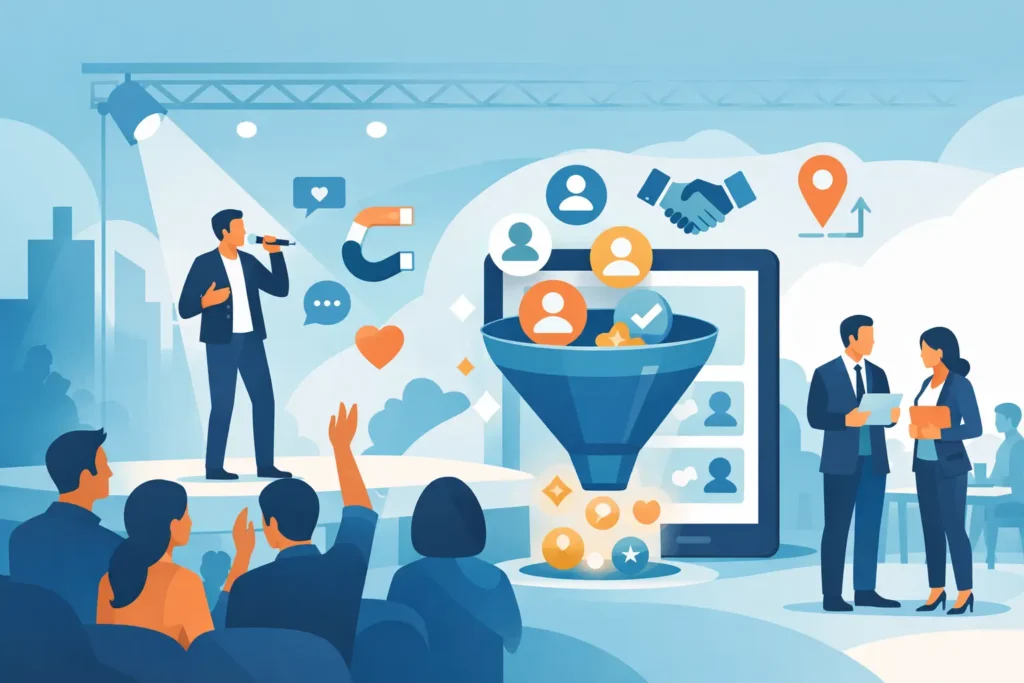
A trade show aisle is a brutal place to ask for someone’s time. Attendees are rushed, overstimulated, and trained to keep walking when they see a badge scanner. So, can performers capture qualified leads? Yes – when the performance is built to create the right conversation, not just a bigger crowd.
A skilled corporate or trade show performer can turn a cold pass-by into an engaged prospect standing in your booth, hearing your message, and speaking with your sales team. The trick is treating entertainment as a lead-generation tool with a clear job to do. Great magic gets attention. Smart event strategy turns that attention into opportunities your team can actually pursue.
Can Performers Capture Qualified Leads? Yes, With a Plan
A performer does not qualify a lead by making a guest laugh, applauding after a trick, or collecting a stack of business cards. Those are signs of activity, not necessarily sales value.
Qualified lead capture happens when entertainment supports a defined path: attract the right attendee, earn enough attention to introduce the brand, create a reason to engage, and hand that person to a prepared sales representative. If any one of those steps is missing, the booth may look busy while the lead report disappoints.
This is why a generic act is rarely enough at a serious exhibition. Your performer needs to understand who you want to meet, what problem your company solves, and what your sales team needs to know before following up. A 90-second customized routine can communicate a key benefit more effectively than a banner nobody reads – especially when it gives attendees a reason to stop and participate.
The goal is not to entertain everyone equally. The goal is to make your ideal prospects want to stay for one more minute.
Crowds Matter, but Crowd Quality Matters More
A busy booth creates social proof. People naturally gravitate toward energy, reactions, and a visible moment worth watching. A polished trade show magician can create that energy repeatedly throughout the day, drawing attendees from the aisle without forcing your team to chase them down.
But a crowd can become a problem if it blocks access, attracts only prize hunters, or leaves no opening for sales conversations. The best booth entertainment is designed with pacing. It gathers a group, delivers a memorable branded moment, and then creates a natural transition for the sales team.
For example, a performer can ask a brief qualifying question before inviting someone into an effect: “Are you responsible for operations, marketing, or procurement?” That is not a hard sell. It is a conversational filter that helps the performer and staff understand why that attendee may be worth a deeper discussion.
The performer can also use a brand-specific premise rather than a vague pitch. If your company reduces shipping errors, improves cybersecurity, or helps HR teams hire faster, the presentation should point toward that outcome. When the magic reinforces a business idea, attendees remember more than a clever trick. They remember why your company was relevant.
Build the Hand-Off Before the Show Opens
The most valuable moment in a lead-generating performance is often the 30 seconds after the applause. That is when a prospect is relaxed, engaged, and already connected to your booth. Your sales team needs to be ready.
Before the event, decide exactly how the hand-off will work. It may be as simple as having a representative step in after the routine and say, “You mentioned you manage regional teams. We help companies like yours solve that challenge. Can I show you a quick example?” The transition should feel like the next part of the experience, not an interruption.
Assign clear roles. The performer draws and engages. A designated booth team member welcomes, qualifies, and scans. Another person may handle demos or schedule meetings. When everybody assumes somebody else is capturing information, good prospects disappear back into the aisle.
Your team should also agree on what counts as qualified. Is it a decision-maker from a target industry? A buyer with an active project? A person who meets company-size, budget, or geographic requirements? Simple qualification criteria prevent the post-show debate over whether “lots of scans” produced anything useful.
Use an Offer That Rewards Real Interest
A giveaway can help, but it should not be the entire strategy. Random prize drawings often bring people who want free items, not a solution. A better offer has a connection to your buyer and creates a reason for a meaningful exchange.
That might be a private product consultation, a benchmark report, an event-only assessment, or entry into a drawing that requires a qualified meeting. The offer does not need to be expensive. It needs to be relevant enough that the right people will raise their hands.
If a performer is inviting attendees to participate, the call to action should be short and visible. Scan a code to receive a useful resource. Ask the sales team for a tailored demo. Book a meeting during the show. The less friction involved, the more likely the moment turns into trackable interest.
Customize the Performance Around Your Message
Customization is where a performer moves from entertainment vendor to strategic event partner. Your audience does not need a ten-minute commercial disguised as a magic show. They need a sharp, memorable experience that makes your message easier to understand and repeat.
The strongest routines use your company name, product category, key benefit, or campaign theme in a way that feels natural. A reveal might feature the brand. A prediction might land on a phrase tied to your value proposition. An interactive moment might demonstrate the exact pain point your audience recognizes.
Keep the message focused. Trade show attendees will not retain seven product features after a short performance. Choose one core idea: speed, accuracy, security, savings, connection, visibility, or another result that matters to buyers. Then give your staff the language to continue that idea in conversation.
This also protects the brand. A corporate performer should be polished enough to work within your event standards, flexible enough to adapt to changing traffic patterns, and experienced enough to engage executives without becoming a distraction from the business purpose.
Measure More Than Booth Traffic
If you want to know whether performers capture qualified leads, track the performance like any other marketing investment. Booth traffic is useful, but it is only the top of the funnel.
Compare traffic during performance windows with quieter periods. Track scans, qualified conversations, booked meetings, demos delivered, and follow-up acceptance. Ask your team to label leads generated during the entertainment activation, even if the final conversation happens a few minutes later.
Then look beyond the show floor. Which leads responded to follow-up? Which became sales opportunities? Which moved into the pipeline? A performer may not close the deal at the booth, but the right performer can create the first moment of attention that makes a future deal possible.
There is a trade-off here. Highly customized performance and lead capture systems require planning, staff time, and budget. A simple strolling magician may be perfect for a hospitality reception where the goal is relationship-building, but a major expo booth needs a more deliberate activation. Match the scope to the stakes.
When Entertainment Is the Wrong Fix
A performer cannot rescue a booth with no clear message, an unprepared team, or a product nobody can explain. If sales reps are unavailable, qualification questions are unclear, and follow-up is slow, entertainment will simply make the missed opportunity more visible.
It is also worth considering your audience. In some technical or highly regulated industries, subtle close-up magic and one-on-one engagement may work better than a loud crowd show. For other brands, especially those competing in packed Las Vegas, Orlando, Chicago, or New York convention halls, a high-energy presentation may be exactly what breaks through.
The format should serve the buyer journey. The best activation feels exciting in the moment and intentional afterward.
A memorable performer gives your booth what most exhibitors struggle to create: a reason for the right people to stop. Give those people a relevant message, a confident sales hand-off, and a clear next step, and the applause can become the start of a real business conversation.