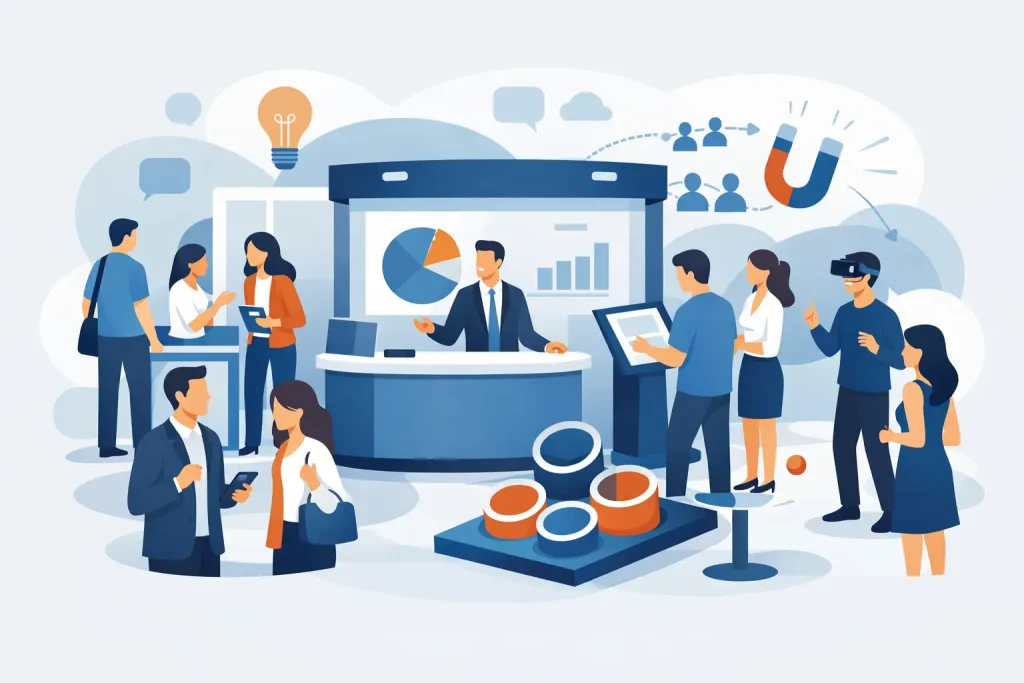
The show floor does not reward the booth with the nicest backdrop. It rewards the booth that gives busy attendees a reason to stop, participate, and remember who started the conversation. The best expo booth engagement tactics are not random giveaways or louder sales pitches. They are designed moments that turn passing traffic into qualified, natural conversations for your team.
That distinction matters. A packed booth can look impressive while producing very few useful leads. A smaller crowd of the right people, engaged around a clear message and handed to a prepared sales rep, can make the entire show worthwhile. Your job is not simply to create activity. It is to create momentum that supports a business outcome.
Start With One Reason to Stop
Attendees make booth decisions in seconds. They scan signage, see whether people are already gathered, and quickly decide whether the experience looks worth their time. If your booth needs a long explanation before it becomes interesting, most people will keep walking.
Your opening hook should be visible, immediate, and connected to what you sell. That could be a short live demonstration, an industry challenge, a surprising visual, or an interactive moment that promises a useful payoff. The offer does not have to appeal to everyone. In fact, it should not. A cybersecurity company may want to attract people willing to test their ability to spot a risk. A software company may invite attendees to solve a workflow problem in 30 seconds.
The strongest hooks create curiosity without hiding the business value. A clever stunt that has nothing to do with your brand may bring a crowd, but it can leave your sales team explaining why anyone should care.
Build the Best Expo Booth Engagement Tactics Around Participation
Passive booth visitors are easy to lose. People who make a choice, answer a question, watch a live outcome, or compete in a brief challenge are far more likely to stay present. Participation gives your team a natural bridge from entertainment to discovery.
Use live performance to create a crowd with purpose
A polished live performer can solve one of the trade show’s hardest problems: getting the first people to stop. When a crowd forms, nearby attendees notice. That social proof draws additional traffic without your staff chasing people down the aisle.
But performance needs a plan. A trade show magician, for example, should not simply perform tricks beside your logo. The best presentations weave in key benefits, a product theme, or a memorable branded line, then introduce attendees to the sales team while interest is high. The entertainment earns attention; the handoff puts that attention to work.
Timing matters, too. Short, repeatable sets usually outperform one long show. You need fresh moments throughout the day, especially during high-traffic windows, not a single crowd that disappears before lunch.
Make the interaction easy to join
Do not require an app download, a complicated registration, or a five-minute tutorial before someone can participate. At an expo, friction is the enemy. The interaction should be understandable from several feet away and accessible in under a minute.
Simple works when it is relevant: choose between two business priorities, predict an outcome, identify a common pain point, or take part in a fast product test. The goal is not to turn your booth into an arcade. It is to give attendees a reason to pause long enough for a real conversation to begin.
Ask a question your buyers actually care about
Generic questions such as “Want to win a prize?” attract people who want prizes. A sharper question attracts people with the problem you solve. Try a prompt such as, “Where does your sales process slow down?” or “Could your team spot this compliance mistake?”
The question should be low-pressure and easy to answer. Once a visitor responds, your staff has context. They no longer need to open with a canned pitch. They can respond to what the person just told them.
Give Your Team a Clear Crowd-to-Lead System
Great engagement can fail at the handoff. A performer creates a crowd, an attendee enjoys the experience, and then no one knows who should speak to them next. That is not a talent problem. It is a process problem.
Before doors open, decide exactly what happens after each interaction. Assign clear roles: one person hosts or supports the activation, one person qualifies visitors, and one person captures details or schedules follow-up. Smaller teams can combine responsibilities, but everyone must know the next move.
Qualify without interrogating people
You do not need a discovery call in the aisle. You need enough information to determine whether a follow-up makes sense. One or two thoughtful questions can reveal role, timeline, current challenge, or buying authority.
For example: “Is this something your team is actively evaluating this year?” is more useful than immediately asking for a badge scan. If the visitor is a fit, earn the scan by offering something relevant – a tailored demo, a meeting time, useful content, or access to a post-show resource. If they are not a fit, thank them warmly and keep the experience positive.
Protect the sales handoff
The moment after a live interaction is valuable. The attendee is engaged, smiling, and open to conversation. Sales reps should be nearby, attentive, and ready with one concise transition tied to the experience they just watched.
Avoid trapping the visitor with a two-minute monologue. Start with a question, listen, and decide whether to continue. The best teams treat the booth as a sequence: attract, engage, qualify, and advance. Each stage has a purpose.
Design for Visibility, Not Just Beauty
A booth can be beautifully designed and still disappear in a busy hall. Your headline should communicate an outcome, not just your company name or product category. Visitors should be able to understand why they might care from the aisle.
Use clear sightlines. Keep the primary engagement area visible rather than burying it behind furniture, counters, or a wall of staff. If you are staging a live presentation, create enough open space for people to gather without blocking the walkway or making it awkward to enter and exit.
Sound is a trade-off. A microphone can help in a large convention center, but an overly loud booth can repel neighboring exhibitors and make conversation impossible. Work with the venue’s rules, test your audio early, and keep the presentation crisp. Energy is valuable; noise for its own sake is not.
Make Giveaways Earn Their Place
Giveaways are not automatically bad. They are just frequently used as a substitute for a strategy. Branded stress balls may increase badge scans, but they rarely create a meaningful reason to remember your company.
A giveaway works better when it is tied to participation or supports the buyer you want to attract. A useful premium gift for attendees who complete a brief assessment can be more effective than a large pile of inexpensive items available to anyone. The trade-off is volume versus relevance. Decide which one serves your show goals.
If you run a prize drawing, make the prize desirable to your target customer rather than universally appealing. You may collect fewer names, but your follow-up list will be cleaner and your team will spend less time sorting through dead ends.
Create Micro-Moments Throughout the Day
Trade show energy rises and falls. The first hour, lunch period, and final afternoon can all require a different approach. Do not rely on one activation to carry an eight-hour day.
Plan brief scheduled moments that give people a reason to return or finally step in: a live reveal at the top of the hour, a fast challenge, a product myth-buster, or a short presentation with a clear takeaway. Promote the timing on a simple sign and have staff invite qualified passersby back.
This is where an experienced corporate performer can be especially valuable. Mike Seege builds customized trade show magic around attention, brand messaging, and warm sales handoffs, helping exhibitors turn those high-traffic windows into business conversations rather than background noise.
Measure What Happened After the Applause
Do not judge engagement by crowd size alone. Track the number of meaningful conversations, qualified leads, demos booked, meetings scheduled, and opportunities that move forward after the event. Ask sales reps to note which interactions produced the strongest prospects.
You should also review the practical details. Which times produced the right traffic? Did the opening hook attract your target audience? Where did handoffs slow down? Were staff members able to have conversations, or were they stuck managing logistics? These answers improve the next show far more than a vague sense that the booth felt busy.
The winning booth is not the one attendees merely photograph. It is the one that makes the right people stop, gives them a memorable reason to talk, and leaves your sales team with a clear next conversation to have.