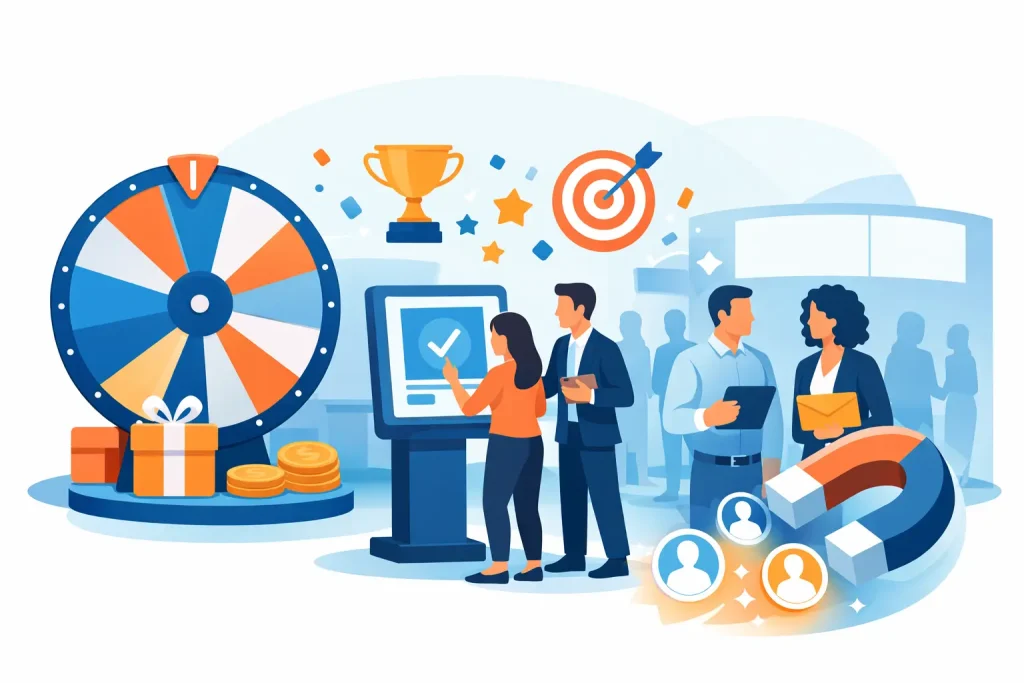
A crowded aisle is not the same thing as a productive booth. If attendees stop, grab a giveaway, and disappear without speaking to your team, you have activity but not momentum. Trade show gamification changes that equation by giving people a reason to engage, participate, and stay long enough for a real business conversation to begin.
For exhibitors, the goal is not to turn the booth into an arcade. The goal is to create a high-energy experience that makes your brand easier to approach, your message easier to remember, and your sales team more likely to walk away with qualified leads. Done well, the game is the invitation. The conversation is the payoff.
Why trade show gamification works
Trade show attendees are making fast decisions all day. They are scanning signage, avoiding hard sells, managing meetings, and trying to find the few exhibitors worth their limited time. A well-designed interactive moment interrupts that pattern. It gives attendees a low-pressure reason to stop before they decide whether they want to hear a pitch.
That matters because people are more open when they have chosen to participate. A quick challenge, a branded reveal, or a chance-based game creates curiosity and gives your booth staff a natural opening line. Instead of asking, “Can I tell you about our company?” they can say, “Want to see if you can beat the challenge?” That is a much easier yes.
The strongest trade show gamification also creates a small emotional win. Attendees might laugh, compete, solve a problem, or feel surprised. Those reactions build memory. When hundreds of booths blend together by the end of the day, the one that created an experience has a better chance of being recalled when follow-up arrives.
There is a business case beyond foot traffic, too. Games can qualify visitors, capture useful data, reinforce a product benefit, and give sales teams a structured way to identify who deserves a deeper conversation. The difference is in the design.
Start with the result you need
Before choosing a game, decide what success looks like at this particular show. More badge scans? Meetings booked? Product demos completed? Awareness in a new market? A stronger pipeline from a targeted list of attendees?
A game designed for maximum traffic may not be the right game for maximum lead quality. A large prize drawing can pull in a crowd, but it may also attract people who want a prize and nothing more. On the other hand, a short product-based challenge may attract fewer visitors while creating far better conversations with buyers who fit your market.
This is where many exhibitors lose the plot. They begin with, “What would be fun?” Start instead with, “What behavior do we need from the right attendee?” If your team needs discovery conversations, build a mechanic that requires a choice or answer. If you need scheduled demos, make the reward available after the appointment is booked. If your product solves a difficult operational problem, make that problem the center of the challenge.
A good game should support the sales process, not sidetrack it.
Match the mechanic to the message
The best experiences are simple enough to explain in five seconds and specific enough to connect back to your company. Think of the game as a live demonstration of your value proposition, not a disconnected booth attraction.
A cybersecurity company might use a fast “spot the threat” challenge. A logistics provider could invite attendees to choose the most efficient delivery route against the clock. A software platform might turn common customer pain points into a quick diagnostic quiz. The attendee gets an engaging moment; your team gets a clean transition into why the solution matters.
For products that are harder to demonstrate on a crowded show floor, a customized magic presentation can be especially effective. The impossible moment earns attention, while the structure of the routine reinforces a product feature, brand promise, or key sales message. It is not magic pasted onto a booth. It is a memorable way to make a complex idea land with an audience that has already seen too many screens and brochures.
Keep the game fast, visible, and easy to join
Trade show floors reward clarity. If people need to read instructions, download an app, create a password, or wait ten minutes for their turn, participation drops. The ideal interaction takes under two minutes, creates visible energy, and allows a newcomer to understand what is happening from the aisle.
Visibility matters because participation is social proof. When attendees see others laughing, competing, or gathering around a presenter, they assume something worth seeing is happening. That crowd becomes a signal that your booth has value. But do not let the crowd become a wall between your team and potential buyers. Design the space so people can watch, enter, and exit without creating congestion.
Prizes should be useful, branded appropriately, and proportional to the action you want someone to take. A premium reward can make sense for a scheduled demo, a completed qualification conversation, or a high-value prospect. A small instant-win item may be enough for a quick interaction. The prize is a nudge, not the whole reason the experience exists.
Avoid offering rewards so disconnected from your business that they overwhelm the brand. If the only thing attendees remember is a giant cash giveaway, your marketing spend may have bought attention without relevance.
Give your booth team a role, not a script
A game will not generate leads by itself. Your people turn attention into opportunity. That means every booth staffer should know where they enter the experience, what question they ask next, and how they hand a promising prospect to the right person.
The transition should feel natural. After a visitor completes a challenge, your team might ask what prompted their choice, whether that issue affects their business, or what system they use now. Those are better questions than launching into a generic pitch because they build from an interaction the attendee has already chosen.
Set clear roles before the show opens. One person can host or perform the experience, another can greet people at the edge of the crowd, and sales representatives can focus on qualified conversations. Without that division, staff often become spectators at their own attraction or, worse, interrupt the game with an awkward sales pitch.
A professional trade show entertainer can help solve this problem by holding attention, managing the crowd, and creating handoff moments for the sales team. The performance should make your representatives look prepared, approachable, and worth talking to. Mike Seege’s customized trade show magic is built around that outcome: draw a crowd, deliver the message, and hand warm prospects to the people who can move the sale forward.
Capture lead information without killing the momentum
The biggest operational mistake is saving lead capture until the very end, then making it feel like payment for playing. People are willing to share information when they understand the value exchange, but the process must be quick and respectful.
For a simple giveaway, a badge scan may be enough. For a more valuable prize or consultation, ask one or two qualifying questions that your sales team will actually use. Role, timeline, current challenge, and buying influence are usually more useful than a long form full of data nobody reviews.
Be transparent about what happens next. If entrants will receive a follow-up email, say so. If a game result leads to a tailored assessment or a meeting, explain that clearly. This protects trust and helps your team separate casual participants from people requesting real help.
Speed is essential. A lead who had an excellent interaction at 2:00 p.m. on Tuesday can forget your booth by Wednesday morning. Sales should receive notes while the conversation is still fresh, and follow-up should reference the actual experience: the challenge they took, the issue they mentioned, or the prize they won. Generic “great meeting you at the show” emails waste the advantage you worked to create.
Measure more than the crowd
A packed booth can make everyone feel successful, but traffic alone is a vanity metric. Track total participants, scans, qualified leads, meetings booked, demos completed, and opportunities created after the event. If possible, compare those numbers with a previous show or a period without an interactive activation.
Also pay attention to quality signals. Did prospects stay long enough to talk? Did your team have time to ask useful questions? Were the right job titles participating? Did the game pull people toward your brand message or simply toward free stuff?
The answers may lead you to adjust the experience. A fast, high-volume game could be perfect for a broad awareness event. A more selective challenge may be better at an industry show where your sales team needs fewer, higher-value conversations. There is no universal winner. The right format depends on your audience, booth footprint, staffing, product complexity, and the action you need visitors to take.
The smart move is to make your booth the place where participation leads somewhere. Give attendees a reason to stop, your team a reason to start a real conversation, and prospects a reason to remember you after the convention center lights go down. That is not just entertainment. That is trade show strategy with a pulse.