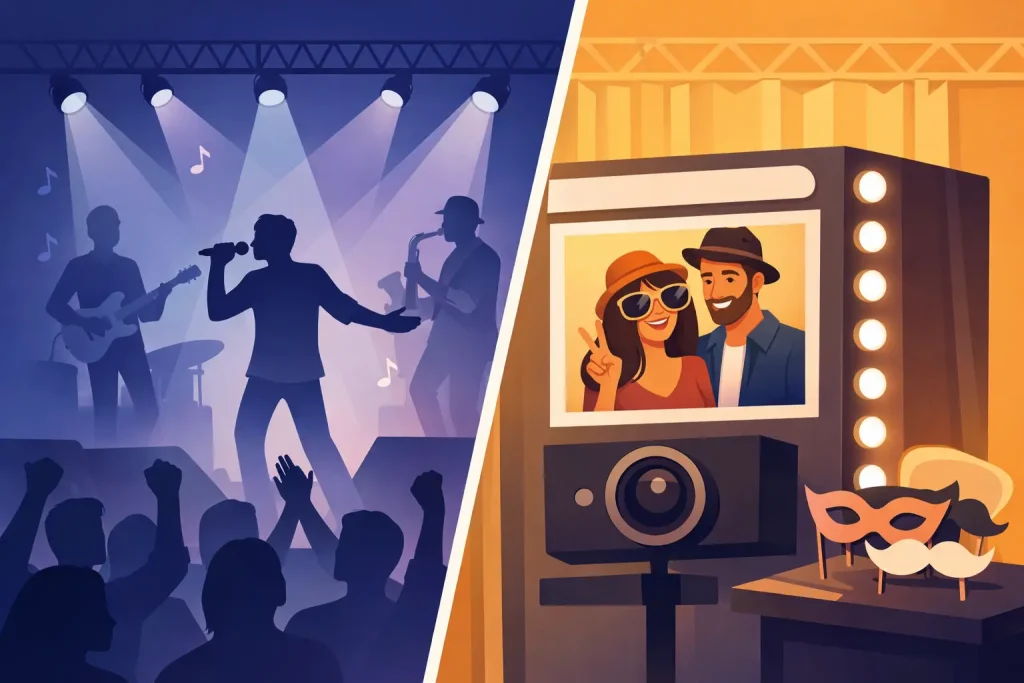
A photo booth can give guests something to do. The right performer can give your entire event something to talk about. That is the real decision behind live entertainment versus photo booth for a corporate gathering, conference, holiday party, or trade show. Both can create a fun moment. But they create very different kinds of value, and that difference matters when your reputation, budget, and event goals are on the line.
A photo booth is familiar, self-directed, and easy to understand. Live entertainment is active. It changes the room, pulls people into the experience, and gives attendees a reason to engage with one another. If your goal is simply to offer a branded takeaway, a booth may be enough. If your goal is energy, connection, attention, and measurable interaction, live entertainment usually has the stronger hand.
Live Entertainment Versus Photo Booth: Start With the Goal
The best choice is not about which option is more entertaining in the abstract. It is about what the event needs to accomplish.
For a company holiday party, you may want employees to mingle beyond their usual departments. For a sales kickoff, you may need a powerful opening that wakes up a room after breakfast and sets the pace for the day. For a trade show, you need qualified conversations at the booth, not just people walking past with a tote bag. For a leadership meeting, you may need an emcee who keeps transitions tight and the audience focused.
A photo booth is primarily a content station. It captures a memory after guests have chosen to participate. Live entertainment creates the moment itself. A skilled corporate magician, emcee, or interactive presenter can approach a group, earn attention quickly, create a shared reaction, and move that energy through the room. That is a much bigger job than taking a picture, and it can produce much bigger results.
What a Photo Booth Does Well
Photo booths earn their place at many events. They are visual, low-pressure, and easy to brand with a logo, backdrop, props, or digital overlay. Guests can visit on their own schedule, take photos with colleagues, and leave with an image that may continue circulating after the event.
They work especially well when the event already has built-in energy. At a lively party with a strong crowd, good food, music, and plenty of social interaction, a photo booth becomes one more attractive stop. It can also be a smart choice when the objective is social content rather than face-to-face engagement.
There are limits, though. A booth cannot read the room. It cannot rescue a quiet reception, connect executives with frontline staff, or refocus an audience when a meeting agenda starts to drag. It waits for guests to come to it. If people are hesitant, tired, or absorbed in their phones, the booth can become an expensive backdrop with a short line and little impact.
What Live Entertainment Brings to the Room
Live entertainment is designed to create momentum. Close-up magic at a reception gives people an instant reason to gather. A headline corporate show gives a room one shared experience instead of dozens of separate ones. A confident emcee keeps the schedule moving, makes speakers look polished, and prevents the energy dip that can turn a full ballroom into a distracted one.
The strongest performers do more than present tricks or tell jokes. They understand audience psychology. They know how to bring people into a moment without making them uncomfortable, how to involve leaders in a way that elevates them, and how to create applause that feels earned rather than requested.
For business events, that interaction is the advantage. Attendees are not merely consuming entertainment. They are participating, reacting, talking, and remembering who made the experience happen. When the performance is customized with your language, product story, or event theme, your message becomes part of the experience rather than another slide on the screen.
At a Trade Show, Attention Is the Currency
The live entertainment versus photo booth question gets clearer on a crowded trade show floor. A branded photo booth can attract occasional visitors, particularly if it offers a fun visual setup. But it rarely creates enough urgency to stop busy attendees who are trying to cover a large exhibit hall.
A live trade show performer can do something more strategic: stop traffic, gather a crowd, introduce a message, and hand interested prospects to the sales team. The entertainment creates the initial curiosity. The presentation delivers the brand point. The sales conversation turns attention into an opportunity.
That does not mean every person watching becomes a buyer. No event tactic can promise that. But a live presentation gives your booth staff a warmer starting point than a cold approach in an aisle. Instead of asking, “Can I tell you about what we do?” they can engage someone who has already stopped, smiled, and heard why the company matters.
This is where entertainment becomes a business tool. The right performer should understand how to work around your lead-capture process, avoid blocking traffic, respect your sales team’s role, and repeat concise messaging without sounding like a commercial on loop. A photo booth may support a booth experience. Live entertainment can drive it.
For Conferences, Energy Management Matters
Conference planners know the difficult truth: a great agenda can still feel flat if the room loses energy. Long sessions, dense content, early mornings, and post-lunch fatigue work against even the best speakers.
A photo booth offers a break during networking windows. That has value, but it does not help during the keynote, awards segment, or transition between speakers. A live emcee or stage performer can actively manage those moments. They can bring the room back after a break, build anticipation for the next speaker, cover an unexpected delay, and keep the event feeling intentional.
For smaller groups, interactive close-up magic can create the same lift without requiring a stage or production build. At a reception, it gives strangers a reason to laugh together. At a VIP dinner, it offers sophisticated table-side engagement without interrupting conversation. At a team program, interactive challenges can reinforce communication and problem-solving while still feeling like a reward, not another meeting.
Consider the Guest Experience, Not Just the Equipment
A photo booth is often simple to add to an event plan. It needs space, power, setup time, and a clear location. Live entertainment requires a different kind of planning: the right format, performer timing, and an understanding of where people will be during the event.
That extra thought is not a drawback. It is how the experience becomes tailored instead of generic. A strolling performer belongs where guests are circulating. A stage feature belongs where you need a shared focal point. An emcee belongs at the center of a program with moving parts. A trade show presentation belongs where attention needs to become conversation.
Ask a practical question: what will guests be doing for the other 90 percent of the event? If the answer is networking, waiting, transitioning, or sitting through content, live entertainment can improve the moments that determine how the event feels. A photo booth tends to serve the few minutes when someone steps inside it.
Budget Is About Return, Not Just Price
Comparing line-item costs can be misleading. A photo booth may appear less expensive because its role is narrower. Live entertainment may require a larger investment because it involves performance expertise, customization, rehearsal, audience management, and sometimes production coordination.
The better question is what outcome your budget is buying. If you need branded images for a party, choose the tool built for branded images. If you need a packed trade show booth, stronger recall for a product message, a room that stays engaged, or a networking event where guests actually connect, paying for active engagement can be the smarter spend.
There is also a risk calculation. A passive attraction cannot recover an event that starts slowly. A polished professional can adapt in real time. They can work the quiet corner, acknowledge the executives, energize a tired audience, and keep the experience moving when the schedule changes. Corporate planners do not just buy entertainment. They buy confidence that the room is in capable hands.
When Using Both Makes Sense
This does not have to be an either-or decision. At a large celebration, a photo booth can provide a branded memento while strolling magic gives guests something memorable to experience throughout the evening. At a conference reception, the booth can capture fun content while a performer prevents the networking floor from breaking into isolated clusters.
The key is to give each element a job. Do not book a booth and a performer simply because the event needs “more.” Use the booth for visual branding and take-home content. Use live entertainment for interaction, attention, energy, and message delivery. When each component has a purpose, the event feels designed rather than overloaded.
Before booking, picture the reaction you want in the room. If you want guests to snap a photo, smile, and move on, a photo booth can deliver. If you want them to stop, gather, laugh, talk to new people, remember your company, and tell colleagues what they just experienced, put live entertainment at the center of the plan. That is how an event becomes more than a date on the calendar.