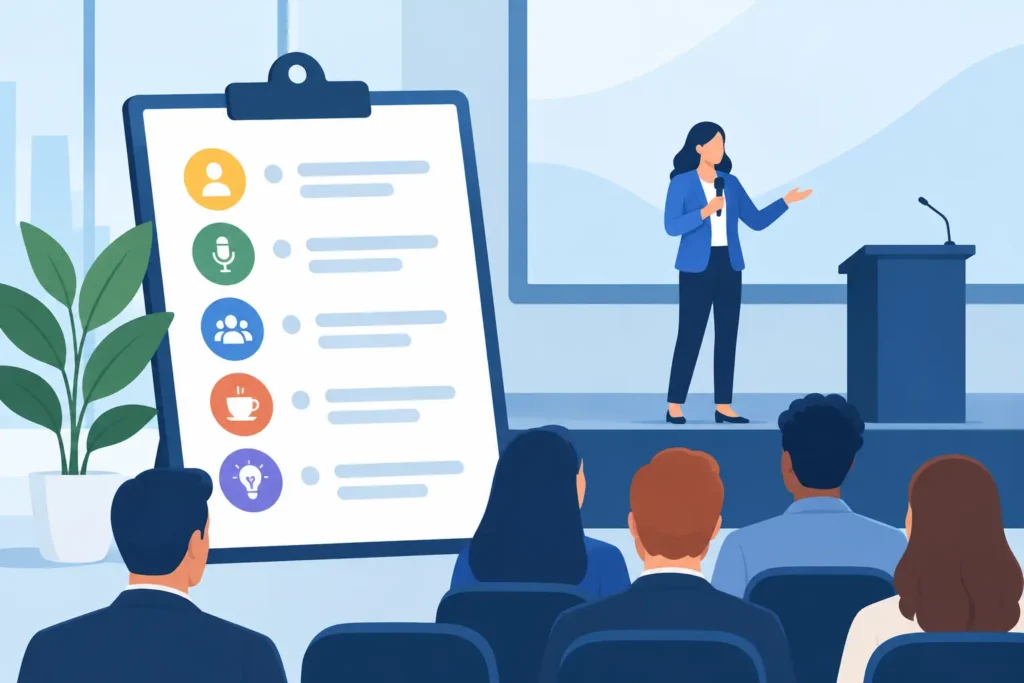
A ballroom full of professionals can lose its energy long before lunch. It happens when a conference agenda feels like a stack of obligations instead of an experience built for real people with limited attention and competing priorities. Smart conference agenda planning changes that. It gives every session a purpose, creates room for connection, and keeps attendees engaged enough to remember why they came.
The goal is not to fill every available minute. The goal is to make the right moments matter. When planners treat the agenda as an audience-engagement strategy, they protect the investment in speakers, sponsors, travel, production, and the event itself.
Start With the Outcome, Not the Time Slots
Before assigning breakout rooms or emailing speaker guidelines, decide what the conference needs to accomplish. A leadership summit may need alignment around a new direction. A sales meeting may need sharper product confidence and team momentum. An industry conference may need stronger networking, sponsor value, and reasons for attendees to return next year.
Those objectives should determine the shape of the day. If your biggest goal is peer connection, scheduling six back-to-back presentations before the first networking opportunity works against you. If executives need attendees to adopt a new strategy, the agenda needs more than a single announcement from the main stage. It needs reinforcement through stories, demonstrations, discussion, and practical application.
Ask one hard question about every agenda item: What should the audience think, feel, or do differently after this? If the answer is unclear, the session may need a stronger brief, a different format, or a shorter place on the program.
Build an Energy Curve, Not a Spreadsheet
Attendee attention rises and falls predictably. Your agenda should anticipate that reality rather than pretend everyone can absorb dense information for eight straight hours.
Open with purpose and pace. The first session should make attendees feel that showing up was the right decision. A strong opening can establish the event theme, create a shared emotional moment, and make the business message feel urgent. It should not bury the room in 70 slides of background information.
Then vary the format. A keynote, panel, customer story, live demonstration, facilitated discussion, and interactive moment all ask the audience to engage differently. That variety is not decoration. It prevents the mental flatline that happens when every hour looks and sounds the same.
The afternoon deserves special protection. Post-lunch programming is where good agendas often lose the room. Place an interactive element, a high-energy host, a compelling case study, or entertainment with a business purpose immediately after the break. A skilled corporate entertainer or emcee can reset attention, reinforce the meeting theme, and give the next speaker an audience that is actually ready to listen.
The trade-off is simple: more variety takes more coordination. But a perfectly tidy agenda that leaves attendees checking email is not efficient. It is expensive.
Give Every Speaker a Job to Do
A recognizable name on the agenda is not a strategy. Speakers need clear roles within the larger experience.
Your opening keynote should create anticipation and frame the conversation. Subject-matter experts should deliver useful depth. Customer voices should add credibility that internal presenters cannot. Executives should provide direction and confidence. A closing speaker should send people out with a message that sticks, not merely signal that the conference is over.
Brief every presenter around the same central promise. They do not need identical slides or talking points, but attendees should be able to connect the dots. If the theme is innovation, one speaker cannot talk only about cost control while another delivers a generic motivational speech and a third presents unrelated product updates. The audience will feel the disconnect even if they cannot explain it.
Be equally honest about session length. Thirty focused minutes can outperform a 60-minute presentation that repeats itself. Panels are especially prone to bloat. Keep the number of panelists manageable, give the moderator a real brief, and make room for useful audience questions. A panel is not automatically engaging just because more people are seated onstage.
Plan Breaks as Part of the Program
Breaks are not empty space. They are where attendees process information, meet peers, visit sponsors, answer urgent messages, and recharge. Conference agenda planning that treats breaks as expendable usually creates rushed guests and disappointed exhibitors.
Make the breaks long enough to work. A 10-minute break in a large convention venue may only give attendees time to find a restroom and return late. Consider the walk time between rooms, the size of the crowd, food and beverage lines, and whether sponsors need meaningful traffic.
For sponsor-supported events, place exhibit time where attendees have a reason to stay. A well-designed activation, a product demonstration, or a live interactive performance can turn a passive booth area into a destination. At trade shows, that same principle can help exhibitors stop strangers, communicate a key message, and hand sales teams warmer conversations instead of a pile of unqualified scans.
Use Interaction With Intent
Not every session needs a poll, table exercise, or audience volunteer. Forced participation can feel like a detour when people came for information. But when interaction supports the message, it turns passive attendance into ownership.
Use it when attendees need to make a decision, practice a skill, compare perspectives, or see an idea in action. Keep instructions simple and the payoff immediate. If a table discussion will take 12 minutes, attendees should know why it matters and what happens with their input afterward.
Interactive entertainment can serve the same function when it is tailored to the meeting. A well-placed performance creates a shared experience, breaks down social barriers, and brings people back to the theme in a memorable way. For teams that have spent all day consuming information, that shift can be the moment that restores the room.
Mike Seege approaches this kind of conference entertainment as a business tool: an opportunity to create energy, reinforce messaging, and make the event feel less like another mandatory meeting. That only works when the performance is positioned intentionally, not dropped into the agenda as filler.
Protect the Transitions
The most polished speakers cannot rescue an agenda that is constantly late, confusing, or technically disjointed. Transitions shape the audience’s perception of the entire event.
Build realistic buffers for walk-ons, video playback, room changes, and Q&A. Decide who owns the clock. Give speakers a clear on-deck process. Confirm what happens if a session ends early, runs long, or a presenter gets delayed.
An experienced emcee earns their place here. Beyond introductions, the right host connects themes, keeps the schedule moving, manages unexpected changes with confidence, and prevents the awkward dead air that makes an otherwise premium event feel improvised. For multi-speaker conferences, that continuity is often the difference between a collection of sessions and a cohesive show.
Create a Better Agenda With These Four Checks
Before finalizing the schedule, pressure-test it from the attendee’s point of view:
- Is there a compelling reason to arrive on time and stay through the final session?
- Does the pace change before attention predictably drops?
- Are breaks long enough for people, sponsors, and logistics to function?
- Can every speaker, activity, and entertainment element be tied to a specific event objective?
If one of those answers is no, revise now. It is far easier to move a block on a planning document than to recover a disengaged room onsite.
Leave Room for What People Will Remember
The best conferences deliver useful information, but information alone rarely creates loyalty. People remember how the event made them feel: welcomed, challenged, energized, connected, and glad they gave it their time.
That means protecting a few moments that are bigger than the slide deck. It may be a powerful opening, a surprising interactive experience, a candid customer conversation, or a closing that gives attendees a clear next move. Those moments are not extras when they support the event goal. They are the proof that the agenda respected the audience.
When you plan your next program, do not ask only whether every minute is filled. Ask whether the room will still be with you at 3:00 p.m., whether sponsors will see real engagement, and whether attendees will have a reason to talk about the event after they get home. Build for those answers, and your agenda starts doing the work your conference was hired to do.