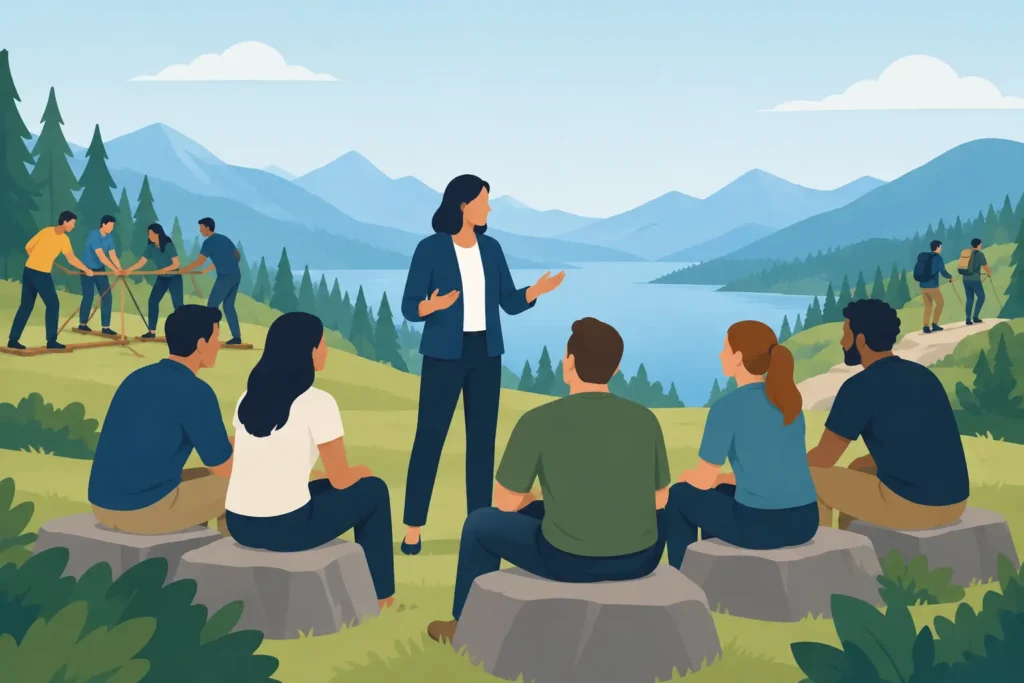
A leadership retreat has a short window to do real work. Pulling senior people away from packed calendars, urgent decisions, and competing priorities is expensive. The best activities for leadership retreats do more than create a pleasant break from the office. They surface the conversations people have avoided, strengthen decision-making under pressure, and give the group a shared experience they can reference long after the agenda ends.
The wrong activity can feel like forced fun. The right one changes the energy in the room, gets leaders communicating differently, and supports the business reason the retreat exists in the first place.
What makes a leadership retreat activity worth the time?
Leadership teams do not need another generic icebreaker. They need experiences with enough challenge to reveal how the team operates: who listens, who assumes, who takes over, who asks better questions, and who can turn disagreement into a clear next step.
That does not mean every session needs to be intense. A well-designed retreat balances strategic work with moments that create trust and momentum. The strongest activities have a clear purpose, a skilled facilitator, and a debrief that connects what happened in the room to what must happen back at work.
12 best activities for leadership retreats
1. The future-back strategy exercise
Ask leaders to imagine it is three years from now and the company has exceeded its most important goal. What changed? What did customers say? What did the team stop doing? Working backward from a successful future forces the group out of incremental thinking and into choices.
This is especially useful when a leadership team has a vision statement but no agreement on the priorities required to make it real. End the exercise by identifying the first two or three decisions that need an owner and a deadline.
2. A leadership communication challenge
Give small groups a complex task with incomplete information distributed among different participants. They can only succeed by listening carefully, asking precise questions, and sharing what they know without turning the discussion into a free-for-all.
The activity itself is not the point. The debrief is where the value lands: Did people make assumptions? Did seniority silence useful input? Did anyone confirm that the group was solving the same problem? These are often the exact habits slowing execution inside the business.
3. The hard-conversation lab
Every executive team has subjects that receive hallway commentary but not focused airtime. A hard-conversation lab creates a structured, time-bound space to name those issues without letting the session become personal or unproductive.
Start with anonymous input on the questions the team most needs to address. Then use a facilitator to keep the conversation specific: What is the issue? What is the business impact? What decision, behavior, or agreement is needed? This works best when leaders are prepared to leave with commitments, not just a more candid discussion.
4. Scenario-based crisis simulation
A simulated crisis brings leadership behavior into sharp focus. The situation could involve a major customer loss, an operational failure, a public relations problem, or a sudden competitive threat. Feed the team new information in stages and require decisions as conditions change.
This is a high-value choice for organizations managing growth, change, or high stakes. It reveals decision bottlenecks quickly. It also shows whether the team can communicate a clear message when not everyone has perfect information.
5. Strengths and blind-spots exchange
A polished version of a personality assessment can be useful, but the real payoff comes from peer feedback. Have each leader identify a strength they bring under pressure and a tendency that can become a liability when that strength is overused.
For example, urgency can become impatience. Careful analysis can become delay. Directness can become dismissal. The goal is not to label people. It is to help the team recognize the patterns that affect trust, meetings, and decisions.
6. Cross-functional problem solving
Choose a real business challenge that no one department can solve alone. Mixed groups develop recommendations, present them to the room, and receive practical pushback. The issue might be customer retention, a new-market launch, recruiting, or improving handoffs between teams.
This activity earns attention because it produces usable ideas while exposing functional silos. Keep the problem narrow enough that teams can make a credible recommendation within the retreat, rather than creating a long list of broad ambitions.
7. A high-energy interactive team challenge
Leadership retreats need moments of release, not just whiteboards and conference-room chairs. An interactive challenge built around communication, observation, and problem solving can reset the room without treating executives like summer-camp attendees.
That distinction matters. A well-run interactive experience feels intelligent, surprising, and inclusive. It gives leaders a chance to laugh, compete, and see one another outside their usual roles, while still reinforcing the behaviors that drive stronger collaboration. Mike Seege’s interactive programs are designed around this balance: high audience engagement with a clear business connection.
8. The customer chair exercise
Place an empty chair in the room and designate it as the customer. During a strategy discussion, anyone can ask, “What would the customer say from that chair?” It is simple, but it interrupts internal assumptions and forces decisions back to market reality.
For greater impact, begin with actual customer feedback, sales-call themes, or support data. Leadership teams can become highly efficient at debating internal constraints. This activity makes sure the customer’s experience is not missing from the conversation.
9. Decision-rights mapping
Slow organizations are often not short on talent. They are unclear about who decides. Give the team a set of recurring decisions, from pricing exceptions to hiring approvals, and map who recommends, who decides, who must be consulted, and who simply needs to be informed.
The conversation can be uncomfortable because unclear authority sometimes protects people from accountability. Still, few retreat activities create more immediate operational value. Leaders leave knowing where to move faster and where collaboration is genuinely required.
10. Personal leadership stories
Ask each leader to share a brief story about a professional failure, turning point, or mentor who changed how they lead. Keep it focused and voluntary, with a clear time limit. This is not group therapy. It is a chance to build context and human connection among people who may only know one another through performance updates.
The trade-off is vulnerability. This works when the team has enough psychological safety, or when senior leaders are willing to set the tone by going first. When done well, it builds trust faster than another round of surface-level introductions.
11. The stop-doing workshop
Most leadership teams can generate more initiatives than the organization can execute. A stop-doing workshop creates room to identify meetings, reports, approvals, projects, or habits that consume energy without producing enough return.
Require evidence, not opinions. What is the cost of this activity? What would happen if it stopped for 90 days? What capacity would it create? This is one of the best choices for teams that feel overloaded and need permission to focus.
12. Commitment and accountability pairs
Close the retreat with each leader naming one behavior they will change, one business commitment they own, and one person who can hold them accountable. Pair leaders across functions when possible. Their check-ins should be scheduled before everyone leaves the venue.
Without this final step, even a powerful retreat can fade into a collection of good conversations. Accountability pairs turn insight into follow-through and give the event a life beyond the agenda.
How to build the right retreat flow
Do not stack high-intensity sessions all day. Start with an activity that establishes connection and participation, move into the strategic work while attention is strongest, then use an interactive challenge to refresh the room before a final decision or commitment session.
The mix depends on the team’s current reality. A new leadership group may need more trust-building and communication work. A seasoned team facing a major market shift may need a crisis simulation, decision-rights mapping, and a future-back strategy session. If conflict is already high, do not hide from it with entertainment alone. Use engagement to lower defenses, then make room for the conversation that matters.
Venue, timing, and facilitation also affect results. A ballroom in Las Vegas or Orlando can support a high-energy group experience, while a smaller offsite may be better for candid strategic dialogue. Either way, protect enough time to debrief. The lesson is rarely contained in the activity itself. It comes from connecting the team’s behavior during the activity to the way it leads when the stakes are real.
A retreat should leave leaders with more than photos, inside jokes, and a folder of slides. Choose experiences that make the team sharper, more honest, and more decisive – then give those commitments a place on Monday morning’s calendar.