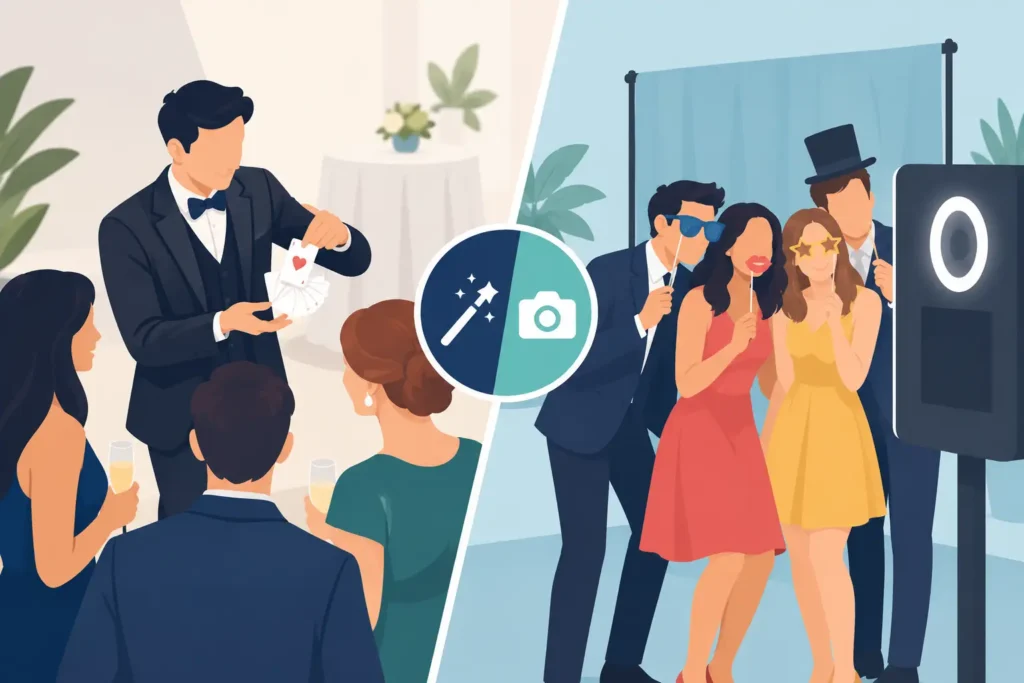
A photo booth can capture a fun moment. Strolling magic versus photo booths is really a decision about what you need that moment to do for your event. Do you want guests to walk away with a branded image, or do you want them talking, laughing, connecting, and remembering the company that created the experience?
For corporate planners, that distinction matters. A great event is not measured only by whether attendees had something to do. It is measured by energy in the room, quality conversations, brand visibility, and whether the investment helped the event feel worth attending.
Strolling Magic Versus Photo Booths: The Core Difference
A photo booth is a destination. Guests choose to visit it, wait for their turn, pose, receive their image, and move on. It is familiar, simple, and highly visual. With the right backdrop, props, and digital sharing options, it can reinforce a campaign or give guests an easy takeaway.
Strolling magic is mobile, personal, and built around live interaction. Rather than asking attendees to find the entertainment, the entertainment finds them. A skilled corporate magician can move through a reception, hospitality suite, dinner, or trade show floor, turning small pockets of polite conversation into groups that stop, react, and engage.
That mobility changes the event dynamic. Magic can reach the quiet corner, the newly arrived guests, the VIP table, and the group that has not yet found a reason to mingle. It creates an opening line when networking feels forced and gives people a shared experience before they have exchanged business cards.
Neither option is automatically better. The right choice depends on the goal, guest flow, room layout, and how much active participation you need from the experience.
When a Photo Booth Makes Sense
Photo booths earn their place when visual branding is the primary objective. If your company has a striking campaign, product launch theme, step-and-repeat wall, or holiday-party concept, a well-designed booth can create a steady stream of branded content. Guests understand it immediately. There is almost no learning curve.
They also work well when people will have downtime and a natural desire to document the occasion. A holiday party, awards dinner, or customer appreciation event can benefit from that keepsake factor. The photo becomes proof that people were there, often with a logo attached.
The trade-off is that the booth usually serves one group at a time. It can become a popular attraction, but it does not automatically create momentum throughout the room. Some guests will participate enthusiastically. Others will never step in front of the camera, especially at a business-focused function where they are dressed for meetings rather than costumes and props.
A photo booth also needs the right physical setup. It requires space, power, a visible location, and enough traffic to justify the footprint. Put it in a low-traffic area and it can become expensive decor. Put it near the bar or buffet and you may create a line that blocks the flow of the event.
When Strolling Magic Delivers More Value
Strolling magic is strongest when the event needs a catalyst. Receptions, networking mixers, client dinners, conference breaks, hospitality suites, and trade show environments all benefit from a performer who can create immediate interaction without stopping the event.
The experience happens in people’s hands, in front of their eyes, and often with their colleagues participating. That makes it naturally shareable. Someone sees an impossible moment, calls over a teammate, and suddenly a small group becomes an energized crowd. The effect is not just entertainment. It is social proof that something worth seeing is happening here.
For corporate guests, this matters because live magic lowers the barrier to conversation. A magician can bring together people who do not know each other and give them a reason to react together. The follow-up conversation is easy: “How did that happen?” From there, introductions and business discussions feel far less mechanical.
At a trade show, the value can be even clearer. Booth staff are often busy trying to attract attention while protecting time for qualified conversations. Strolling or customized trade show magic can gather prospects, hold them long enough to hear a message, and give sales representatives a warmer opening. The performance is not the finish line. It is the crowd-building mechanism that helps the sales team start better conversations.
Engagement Is Not the Same as Attendance
One of the biggest planning mistakes is treating every activation as interchangeable because both are technically “interactive.” A photo booth asks guests to participate in a transaction: pose, smile, collect. Strolling magic asks guests to participate in a live moment: choose a card, make a decision, hold an object, watch a colleague become part of the impossibility.
That difference produces different kinds of memory. The photo preserves what the guests looked like. Magic preserves how the guests felt.
For an event built around brand connection, team chemistry, or high-energy networking, feeling usually carries more weight. People may post the photo, but they tend to retell the impossible moment. When the performance is customized thoughtfully, the brand can become part of the story rather than just the logo in the corner of an image.
Of course, customization should serve the event, not interrupt it. Guests can spot a forced sales pitch instantly. The best corporate magic uses brand themes, product benefits, or key messages in a way that feels surprising and entertaining first. That is how a message earns attention instead of demanding it.
Consider the Guests Who Do Not Volunteer
This is where strolling magic often has a major advantage. Photo booths appeal most to guests who already like being photographed. At many corporate events, that is only a portion of the room. Executives, reserved attendees, and guests arriving alone may skip it altogether.
A polished strolling magician can read the room and approach people gracefully. There is no pressure to pose or perform. Guests can simply watch, then find themselves drawn in as the moment builds. The result is broader participation across age groups, roles, and personality types.
That is especially valuable for events with a mixed audience. If you are hosting clients, prospects, employees, leadership, and partners in the same room, you need an experience that feels upscale without being stiff, fun without being childish, and visible without demanding everyone’s attention at once. Close-up magic handles that balance exceptionally well.
Budget, Logistics, and Event Flow
Budget should be assessed by outcome, not just by line-item cost. A photo booth may be the efficient choice when you need a simple visual activation that can operate for several hours with little coordination. It can also complement another entertainment element nicely.
Strolling magic is more valuable when you need an active host of energy. The performer adapts to the crowd, works around dinner service and speeches, fills lulls, and reaches attendees where they are. That flexibility can protect the guest experience when schedules shift or attendance patterns change.
For a large reception, a photo booth alone may create one busy corner while the rest of the room remains fragmented. A magician can circulate through that entire room. For a small gathering with a highly designed visual theme, the booth may be the better fit. For a major trade show, the strongest strategy may include both: a visual destination for content and a live performer who draws prospects into the space.
The key is to avoid treating the activation as an afterthought. Decide where guests will gather, what behavior you want to encourage, how the sales or event team will capitalize on that activity, and what success looks like when the evening ends.
Choose the Experience That Supports Your Goal
If the goal is branded photos, social sharing, and a predictable self-service attraction, choose a photo booth and give it a location guests cannot miss. If the goal is better networking, bigger trade show crowds, stronger audience energy, and a memorable reason for people to talk about your event afterward, strolling magic is built for that job.
Mike Seege approaches corporate magic as more than a clever interruption. The performance is designed to create reaction, connection, and opportunities for your team to engage with the people who matter.
The best choice is the one that gives guests more than a moment to fill. Give them a story they will carry into the next conversation, the next meeting, and the next time someone asks whether your event was worth attending.