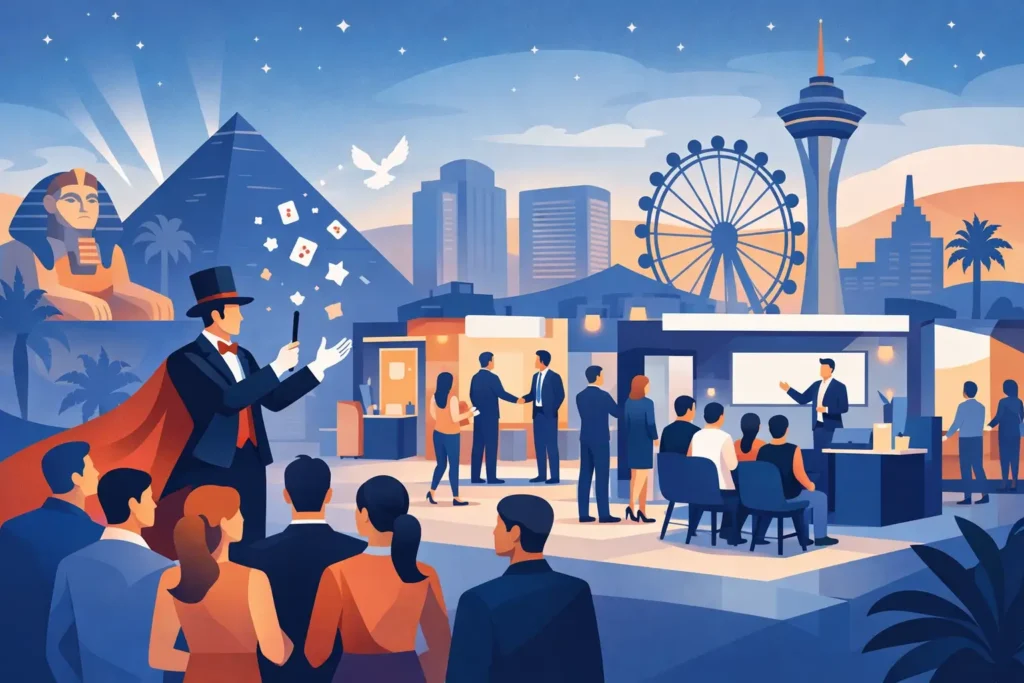
A Las Vegas show floor gives attendees hundreds of reasons to keep walking. Bright graphics, giveaways, demos, cocktails, celebrity appearances, and competitors with equally polished booths all compete for the same few seconds of attention. Las Vegas trade show magic gives people a reason to stop, engage, and remember who invited them in.
That difference matters when your team has invested in booth space, travel, staffing, sponsorships, and a sales follow-up plan. A skilled trade show magician is not there to perform tricks in a corner. The performance is designed to build a crowd, create a natural opening for conversation, and hand your sales team warmer, more receptive prospects.
Why Booth Traffic Alone Is Not the Goal
A packed aisle can look impressive while producing very little value. If visitors watch for thirty seconds, grab a giveaway, and disappear without learning what you do, your booth generated activity, not opportunity.
The real objective is to turn attention into interaction. The right performer creates a visible moment that pulls people from the aisle, then gives your team a clean transition into the message that matters: a product launch, a new capability, a problem your company solves, or a reason to schedule a meeting.
That is where trade show magic earns its place in the event strategy. It creates an emotional break in a busy, information-heavy environment. Attendees laugh, react, take out their phones, and gather closer. Your brand becomes attached to that moment of surprise, which makes the next conversation easier for your staff to start.
What Effective Las Vegas Trade Show Magic Looks Like
The strongest trade show performance has structure. It is not a roaming entertainer hoping someone pauses long enough to watch. It is a repeatable crowd-building system tailored to your booth footprint, audience flow, staffing plan, and sales objective.
A performer may begin with quick, visual close-up effects at the edge of the booth to interrupt aisle traffic. As a few people stop, the presentation expands into a short, high-energy routine that can be seen by a small crowd. That crowd becomes social proof. People walking by see engagement already happening and want to know what they are missing.
The best moments can incorporate your company name, a key phrase, a product benefit, or a branded item. The customization should feel like part of the experience, not a commercial awkwardly dropped into a magic trick. When the message is woven in naturally, attendees remember both the surprise and the company behind it.
For a busy exhibit hall, short sets usually outperform one long show. A six- to ten-minute presentation can be repeated throughout the day, accommodate changing traffic patterns, and leave room for sales conversations between groups. The exact format depends on your booth location, the event rules, your staffing level, and whether you are selling a quick-turn product or a complex enterprise solution.
Design the Handoff Before the Show Opens
The magician can create the opening. Your team has to be ready to capitalize on it.
Before the event, decide what should happen immediately after the applause. Perhaps attendees scan a badge to enter a drawing, choose a demo time, answer one qualifying question, or meet a product specialist. Keep the next step easy. If a prospect has to navigate three forms or wait while staff decide who should speak to them, the energy fades fast.
Sales staff should also know how to approach a group without breaking the mood. A simple line works better than a rehearsed pitch: “What brought you to the show?” or “Are you dealing with this issue in your business?” The goal is not to force every spectator into a full presentation. It is to identify the people worth continuing with and give everyone else a positive brand experience.
Assign clear roles. One person can manage lead capture, another can greet new arrivals, and product experts can be available for deeper conversations. If your booth team is small, use fewer performance windows and protect time for follow-up. A constant crowd is only helpful when someone can work it.
Make the Brand Part of the Impossible Moment
Generic entertainment may be fun, but branded entertainment is more useful. In a Las Vegas convention center, attendees will see plenty of impressive things. Your objective is to ensure they connect the memorable moment to your company rather than simply remembering a magician.
Customization can be subtle. A deck of cards may reveal a product promise. A borrowed object may transform into a branded item. A prediction can highlight the challenge your audience faces and point toward your solution. The effect itself must remain strong, because a weak trick with a heavy sales message feels forced. But when the business idea supports the surprise, the message lands with far more staying power than another brochure headline.
Avoid trying to include every feature, service line, and corporate slogan. One message per routine is usually enough. Choose the point that will help your sales team open the right conversation. For example, a cybersecurity company may emphasize risk visibility, while a logistics provider may center the experience on speed, precision, or control.
Plan for the Realities of the Las Vegas Floor
Las Vegas trade shows move fast, and logistics can make or break an otherwise excellent idea. A booth near a food station, main entrance, or major aisle may need a more visual approach because the noise level is high and traffic is constant. A smaller booth in a quieter section may benefit from more intimate close-up engagement that encourages people to step inside.
Sound restrictions matter. So do ceiling height, demo stations, neighboring exhibitors, union regulations, and your event organizer’s policies. A professional trade show magician plans around these variables rather than arriving with a one-size-fits-all act.
Timing matters too. Peak traffic often arrives after keynote sessions, during afternoon lulls when exhibitors need an energy boost, and near the end of the day when attendees are deciding which booths were worth revisiting. Instead of booking entertainment as a background feature for every hour, schedule strategic performance blocks around the moments your booth needs momentum.
If you are hosting a client reception or hospitality suite after the exhibit hall closes, the approach can shift. Strolling magic keeps introductions flowing among smaller groups and helps prevent the room from splitting into familiar cliques. The same performer can support both environments, but the pace and goal should be adjusted.
How to Measure More Than Applause
Applause is a good sign. It is not the final metric.
Set a baseline before the show: average badge scans, demo requests, qualified conversations, appointments booked, or traffic during specific periods. Then compare performance windows with quieter periods. Your results will not always be perfectly scientific because trade show traffic changes throughout the day, but tracking gives you a clearer picture than judging success by crowd size alone.
Ask salespeople for qualitative feedback as well. Did attendees arrive more relaxed? Did the brand message give them an easy opener? Were the leads better qualified? Did prospects mention the performance later in the conversation or in follow-up emails? Those signals reveal whether the entertainment supported the actual selling process.
A smart post-show follow-up can extend the effect. Reference the moment people experienced at the booth, especially if they opted into a meeting or received a branded takeaway. It is a more human re-entry point than a generic “great to meet you at the show” message.
Choose a Performer Who Understands Business Pressure
Not every magician is a trade show magician. A great private-party performer may be highly entertaining but unfamiliar with short repeatable sets, brand integration, lead capture flow, and the practical pressure on an exhibitor to prove return on investment.
Look for a performer who asks about your audience, message, booth size, staff roles, traffic goals, and the action you want attendees to take. You want someone who can hold attention without blocking access to your team, adapt when the aisle suddenly surges, and communicate professionally with show management and your onsite contacts.
Mike Seege approaches corporate magic as a business tool: create the crowd, build the moment, reinforce the message, and help the sales team start better conversations. That is a much different assignment than simply entertaining people between meetings.
Your booth does not need to be the loudest one in Las Vegas. It needs to be the one attendees can still describe when their flight home lands. Give them a moment worth repeating, and give your team a clear next step while that moment is still fresh.