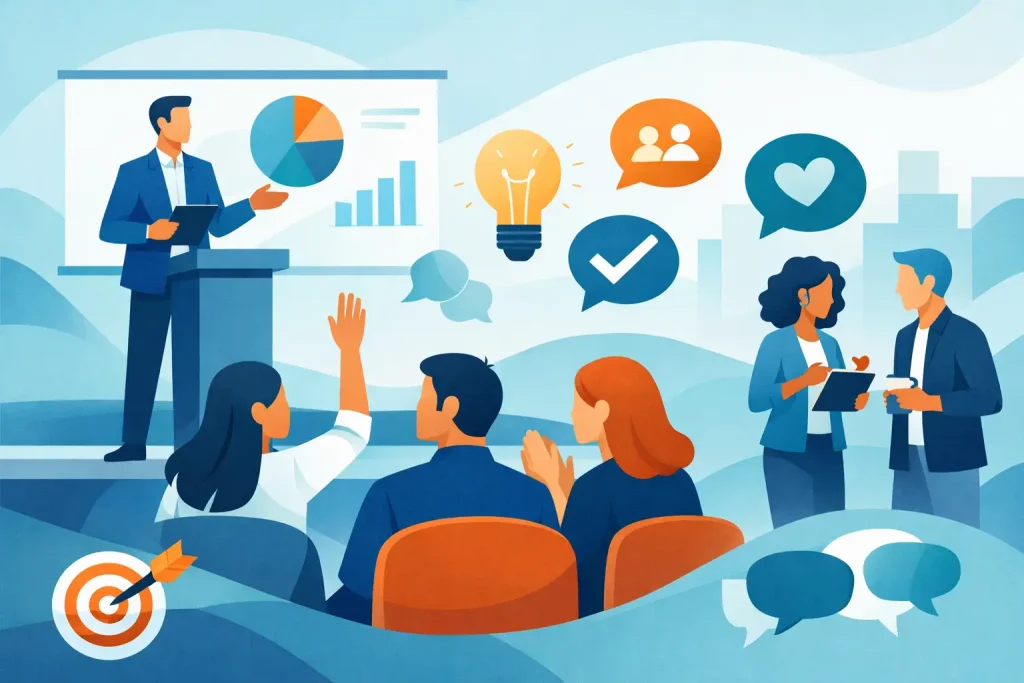
A conference can have a beautiful venue, a strong speaker lineup, and a packed registration list – then lose the room by 10:30 a.m. The difference between a productive event and a forgettable one is knowing how to keep conference attendees engaged from the opening moment to the final takeaway.
For planners, that means thinking beyond the agenda. Attendee engagement is not one activity squeezed between keynote sessions. It is the intentional management of attention, energy, participation, and relevance across the entire event. When the room is involved, people retain more, network more freely, and leave with a stronger impression of the company behind the conference.
Engagement Starts Before Anyone Takes a Seat
The best conference experience begins before the first badge is printed. Your attendees should understand what is in it for them: a useful idea, a meaningful connection, a solution to a problem, or access to people they would not otherwise meet.
Build your agenda around a clear event promise. A sales kickoff may promise practical momentum for the year ahead. A leadership summit may promise sharper alignment. A customer conference may promise direct access to insights and peers. That promise should shape the session topics, speaker briefs, room setup, and attendee communications.
Pre-event input also gives people a stake in the program. Ask registrants what they want answered, what challenges they are facing, or which topics matter most. Then use those responses on stage. When a speaker says, “Many of you told us your biggest challenge is adoption,” attendees immediately recognize that the event was designed for them, not simply delivered at them.
How to Keep Conference Attendees Engaged All Day
Attention is a limited resource. A well-known keynote can earn focus at 9 a.m.; the same format can struggle after lunch, after three presentations, or at the end of a long travel day. Smart planners design for energy changes instead of hoping attendees will power through them.
Break up passive sessions
Long blocks of presentation-heavy content put even motivated audiences into spectator mode. Give speakers a brief that requires a change of pace every 10 to 15 minutes. That might mean a question from the stage, a quick peer discussion, a live poll, a demonstration, or a short story that shifts the emotional tone.
This does not mean every session needs games or forced participation. Senior executives may respond better to a sharp decision-based discussion than a high-energy icebreaker. Technical audiences may prefer live problem-solving or product demonstrations. The right interaction depends on the audience, but the core principle stays the same: attendees need a reason to do more than sit and listen.
Treat transitions as programming
Transitions are where energy leaks. A late speaker, an awkward handoff, or 12 minutes of dead air can make an event feel disorganized fast. A strong emcee prevents that loss of momentum by connecting sessions, resetting the room, recognizing audience contributions, and keeping the schedule moving.
An emcee is not simply a person who reads introductions. The right host reads the room. If a session lands with big energy, they can carry it into the next moment. If the room is fading, they can lift the pace before the next speaker walks out. That kind of attention management protects your agenda and makes your event feel professionally produced.
Build in surprise without sacrificing purpose
People remember contrast. If every segment looks and sounds the same, even strong content begins to blur together. An unexpected interactive moment gives attendees a mental reset and creates a memory marker around your message.
That is where purposeful entertainment earns its place. A corporate magician, for example, can open a general session with a high-impact moment, re-energize the room after lunch, or reinforce a message through a customized presentation. The goal is not to add a random act to the schedule. The goal is to create a shared experience that makes the audience more receptive to what comes next.
At a conference, Mike Seege uses interactive magic as a business tool: getting people involved, creating laughter and surprise, and tying those moments back to the event’s message. When attendees become part of the moment, they stop checking email and start paying attention.
Make Networking Easier to Start
“Networking time” is often code for attendees standing near coffee stations with people they already know. If connections are a major reason people attend, give networking more structure.
Create prompts that make conversations useful right away. Place a question on tables, organize meetups by role or industry challenge, or use a host to bring people into conversations. At a welcome reception, strolling close-up magic can be especially effective because it gives strangers an immediate shared experience and an easy opening line. Instead of asking, “So, what do you do?” guests are reacting to something surprising together.
The trade-off is timing. Over-programming every break can make people feel managed rather than welcomed. Leave room for organic conversation, but offer enough structure that quieter guests and first-time attendees are not left on the sidelines.
Give Attendees a Role in the Story
Engagement rises when people can see themselves in the content. Replace generic case studies with audience-relevant scenarios. Bring customers, frontline employees, or partners into the conversation. Invite live questions before the session starts, then answer the best ones from the stage.
Technology can help, but it should not become the event. Live polls, Q&A tools, and session feedback create useful signals when the questions are specific. “How engaged are you?” produces little value. “Which barrier is slowing implementation at your company?” gives a speaker a real direction and gives attendees a reason to participate.
For larger audiences, visible participation matters. Display poll results on screen. Let a speaker respond to what the room says. Ask attendees to make a choice, compare perspectives with a neighbor, or contribute an idea that shapes the next segment. Participation works best when attendees can see that their input changed something.
Design the Room for Attention
Engagement is physical as well as intellectual. A room that is too cold, too dark, too crowded, or too difficult to navigate will drain attention before your content has a chance.
Choose a format that fits the objective. Theater seating concentrates attention for a keynote or headline performance. Rounds support conversation and workshop-style learning. Cabaret seating can work well when you want both stage focus and table discussion. For a trade show presentation, position the performance so passersby can see and hear enough to be curious, while keeping the sales team ready to continue the conversation once the crowd gathers.
Also protect the basics: clear sightlines, crisp audio, comfortable temperatures, and breaks scheduled before exhaustion sets in. These details are not glamorous, but they determine whether the audience can receive the experience you paid to create.
Measure More Than Applause
A standing ovation feels great. It is not the only measure of success. Before the event, decide what engaged behavior looks like for your organization. It could be session attendance, app participation, questions submitted, qualified trade show leads, meetings booked, post-event survey scores, or use of a new internal initiative after the conference.
Then connect each program element to a job. A keynote may set direction. A facilitated exercise may test understanding. Interactive entertainment may restore energy and make a core message memorable. A booth presentation may draw a crowd and give salespeople an opening to qualify prospects.
This approach also makes budget decisions easier. Not every event needs a headline show, and not every speaker needs an interactive segment. But if the agenda contains a predictable energy dip, a networking challenge, or an important message that cannot afford to be forgotten, it is worth investing in an experience built to solve that specific problem.
End With Momentum, Not an Exit Queue
The closing session should not feel like the point when attendees are permitted to leave. Give them a final moment that brings the event’s ideas together, recognizes their contribution, and points them toward the next action.
That action might be a commitment conversation at the table, a meeting with a product specialist, a follow-up resource, or a challenge to apply one idea within the next week. Keep it simple and concrete. A high-energy closing experience can send people out talking, but the real win is sending them out with a reason to act.
The conferences people remember are not necessarily the ones with the longest agendas or the biggest stages. They are the ones where attendees felt seen, involved, energized, and clear on why their time mattered. Build for those moments deliberately, and your conference will keep working long after the ballroom lights come up.