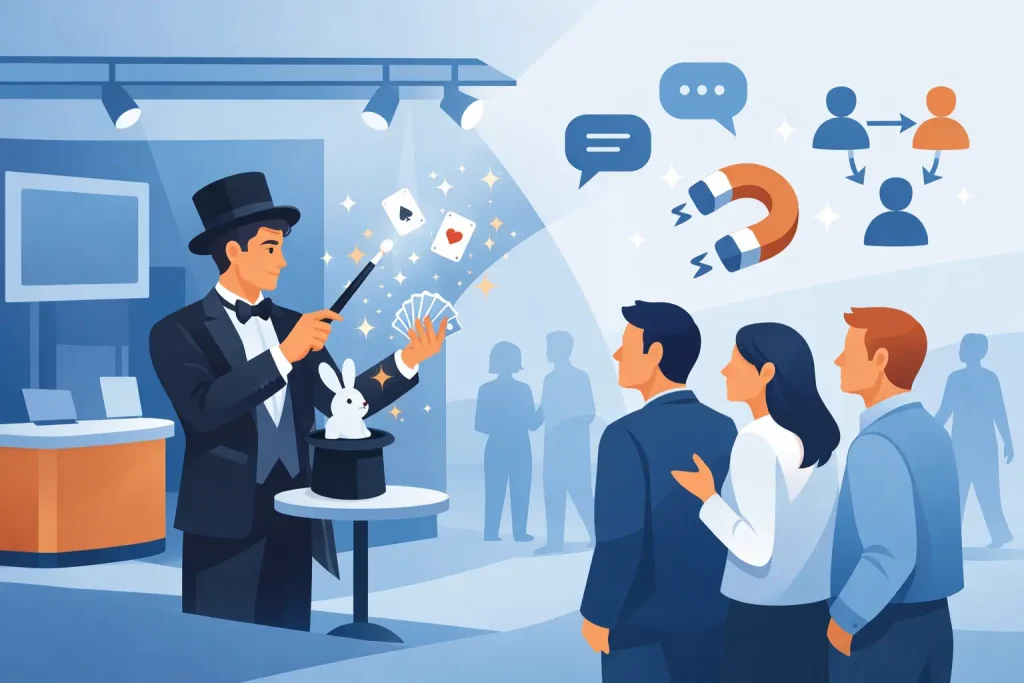
The aisle is busy, your booth is open, and your sales team is ready. Then attendees walk right past because every exhibitor is asking for the same thing: a minute of their time. A trade show booth magician changes that equation. Instead of chasing people down with a badge scanner, your team has a crowd, a reason to start a conversation, and a natural opening to turn curiosity into a qualified lead.
This is not entertainment added to a booth as an afterthought. Done well, trade show magic is a live sales-support tool. It earns attention in a crowded hall, delivers a message people actually hear, and creates the kind of memorable moment attendees mention later when they are deciding which booths were worth visiting.
Why a Trade Show Booth Magician Changes the Traffic Problem
Trade show attendees are not short on options. They are short on attention. They have meetings to make, booths to visit, giveaways to collect, and a growing instinct to avoid anyone standing in an aisle with a scanner and a scripted opening line.
A professional magician gives them a different reason to stop. They see a small crowd, hear laughter or applause, and want to know what is happening. That social proof matters. A booth with energy looks like a booth worth investigating.
The best part is what happens after the first stop. The performance creates a brief but valuable pause. Rather than forcing your sales team to interrupt someone who is already moving away, they can step into a warm conversation while the attendee is engaged, relaxed, and receptive.
That is the difference between booth traffic and useful booth traffic. A crowd alone is not a result. A crowd that receives your message and meets the right salesperson is.
Attention is the first step, not the finish line
A quick visual effect can stop attendees in their tracks. But a trade show presentation should immediately give that attention a business purpose. Your company name, product category, key differentiator, or campaign theme can be integrated into the routine so the reveal supports the message rather than competing with it.
For example, a technology company may need to communicate speed, security, or simplification. A healthcare brand may want to emphasize accuracy and trust. A company launching a new platform may need attendees to remember one clear promise. The magic should make that idea feel more vivid, not bury it under a complicated trick.
When attendees walk away saying, “That was amazing,” but cannot remember who sponsored it, the performance missed the assignment. When they say, “That company with the incredible demo about solving that problem,” your booth has earned a place in their memory.
What a Trade Show Booth Magician Actually Does
The strongest booth performers operate with the awareness of an experienced event partner. They read the room, manage crowd size, work around demos and meetings, respect neighboring exhibitors, and know when to build energy versus when to keep the footprint tight.
A customized performance generally works in short, repeatable sets. That matters because trade show traffic is always changing. The performer can draw a group, deliver a concise branded moment, and help create a handoff to your team before repeating the process for the next wave of attendees.
The sales team should not have to guess what happens next. Before the show opens, establish a simple lead handoff process. Maybe a team member joins the crowd near the end of the presentation. Maybe the performer asks a question that identifies attendees with a relevant need. Maybe the next step is a product demo, a meeting booking, or a scan for a specific giveaway.
The method depends on your sales cycle. A company selling a high-consideration enterprise solution may prioritize five-minute discovery conversations with ideal prospects. A brand introducing a consumer-facing product may focus on brand exposure, social sharing, and volume. Both can benefit from magic, but they should not measure success in the same way.
Build the Show Around the Sales Conversation
The most effective performances are planned backward from the action you want attendees to take. If your goal is meetings, the routine should end with a clear invitation to meet an expert. If your goal is demonstrations, it should create a clean bridge into the product experience. If you are launching a campaign, it should reinforce the phrase or idea your audience needs to recall later.
Keep the message focused
Trade show floors are loud. Attendees are distracted. Trying to communicate six product benefits during a three-minute presentation is a fast way to make none of them stick.
Choose one primary message and one supporting proof point. A skilled performer can make those points feel conversational and entertaining, but the strategy needs to be clear before the scripting begins. The goal is not to turn a magic act into a PowerPoint presentation. It is to make your most valuable idea impossible to ignore.
Give your team a role
Magic can create the opening, but your people close the gap. Brief booth staff on when to approach, how to introduce themselves, and what question to ask first. The simplest transition is often the strongest: “What brought you to the show?” or “Are you dealing with that challenge in your organization?”
Assigning one person to engage while another captures lead details prevents the common problem of a busy booth that produces little usable follow-up. The performer attracts and organizes attention. Your team turns that attention into opportunity.
Plan for the physical booth
A large island booth gives you room for bigger crowds and scheduled presentations. A smaller inline space may call for close-up magic at the edge of the booth, with compact groups that do not block your display or overwhelm neighboring exhibitors.
Neither format is automatically better. The right approach depends on your floor plan, show rules, staffing level, and how much time your team needs with each prospect. A good performer will ask about these details early because logistics shape results.
When Trade Show Magic Works Best
A trade show booth magician is especially valuable when your company needs to stand out in a dense exhibit hall, launch a product, revive a tired booth schedule, or give a new sales team a reliable way to begin conversations. It also works well for companies whose value proposition is strong but difficult to explain in a quick pass down the aisle.
There are trade-offs. If your booth is already packed with scheduled private meetings, a large crowd may not serve your objective. If your team has no capacity to follow up with visitors, generating more leads can create more work without improving results. And if the performer is hired with no briefing on your audience or message, you may get applause without business impact.
That is why the right fit matters more than simply booking someone who knows a few tricks. Look for a corporate performer who understands branding, timing, lead flow, and the pressure attached to an expensive exhibit investment. Mike Seege builds trade show presentations around those realities, turning live entertainment into a practical advantage for the people working the booth.
Questions to Ask Before You Hire
Before bringing a performer into your exhibit strategy, get specific about the outcome. Four questions will reveal whether the plan is built for more than a momentary crowd:
- How will our brand message appear in the performance?
- What happens when the routine ends and attendees are ready to talk?
- How will the performer adapt to our booth size, show hours, and traffic patterns?
- What metrics will tell us whether the investment worked?
The answers should be concrete. “We will get lots of people” is not a strategy. “We will run six short branded presentations per hour, assign two team members to each handoff, and track scans, demos, and booked meetings” is a strategy.
Measure More Than Applause
Applause is a useful signal. It means people stopped, watched, and responded. But event leaders need to report on outcomes that make sense to marketing and sales.
Track total booth visitors, qualified conversations, badge scans, demo participation, meetings booked, and follow-up response rates. Compare those numbers with previous shows or with time periods when the booth was not running a presentation. Ask your sales team whether the conversations felt warmer and whether attendees remembered the message without being prompted.
You may also find value that does not fit neatly into a scanner report. A high-energy booth can improve staff morale during a long show day, give social teams better visual content, and make your brand easier for attendees to describe to colleagues. Those benefits do not replace lead metrics, but they can amplify the return on the exhibit investment.
The next time you are staring at a floor plan and wondering how to compete with hundreds of neighboring booths, do not settle for being another friendly face asking, “Can I scan your badge?” Create a moment attendees choose to join, then give your team a clear path to make that moment count.