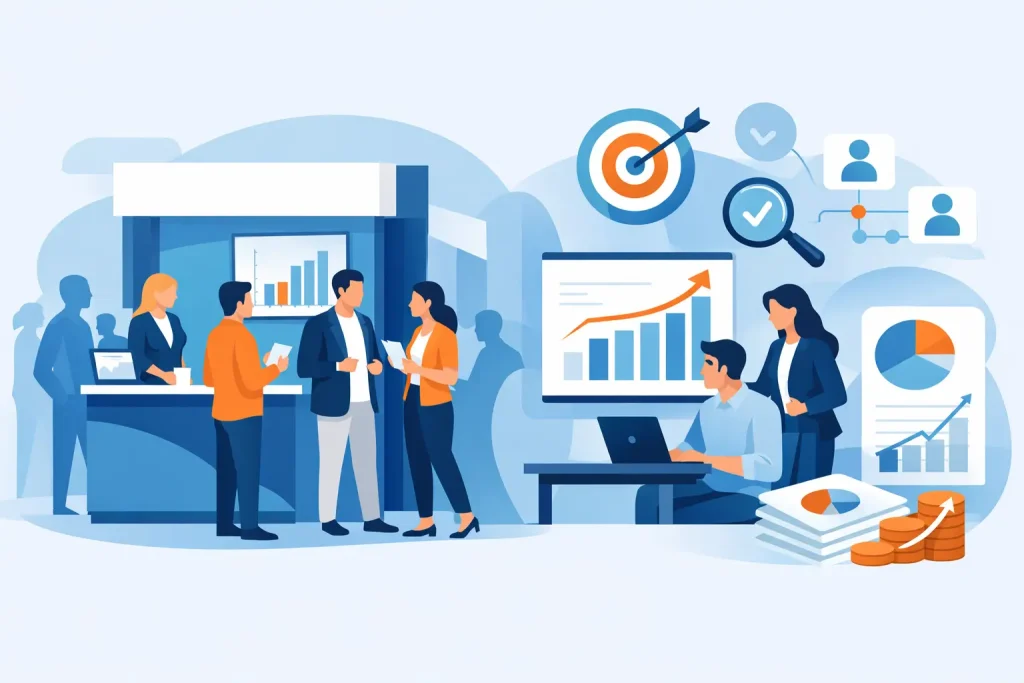
A busy booth can feel like a win until the show floor closes and the sales team asks the only question that matters: what did that traffic produce? Booth engagement results are not measured by a crowd photo, a bowl of scanned badges, or compliments about the display. They are measured by the number of relevant people who stopped, stayed, understood your message, and gave your team a real reason to follow up.
That distinction changes how you plan the entire exhibit. The goal is not to entertain attendees for its own sake. The goal is to create enough curiosity and energy to start quality conversations in a crowded environment where every competitor is trying to do the same thing.
Start With the Business Result You Need
Before choosing giveaways, demos, staff scripts, or entertainment, define the outcome that justifies being at the show. A new product launch may need awareness among a narrow buyer group. A mature company may need booked meetings. A service business may need to identify prospects with a problem, budget, and timeline.
Those goals require different forms of engagement. If your team needs executive-level meetings, a giant crowd of students and casual attendees may be a distraction. If you are entering a new market, volume and repeated exposure may matter more. Strong booth strategy begins when marketing and sales agree on what a qualified interaction actually looks like.
A useful qualification standard answers three questions: Is this person in the right role or account? Is there a relevant need? Is there a sensible next step after the show? Your team does not need every visitor to meet all three immediately. But it does need a clear way to separate promising conversations from pleasant booth traffic.
What Booth Engagement Results Should Measure
Raw lead counts still matter, but they are a starting point, not a verdict. A booth that captures 500 badge scans with no meaningful conversations can create hours of follow-up and little pipeline. A booth that captures 120 well-qualified leads and books 25 demonstrations may have delivered much greater value.
Track results across the full interaction, from attraction to action. The most useful measures usually include:
- Total booth visitors and the number who fit your target audience
- Average dwell time, especially for scheduled demos or presentations
- Conversations started by the sales team after the initial attraction
- Qualified leads, booked meetings, demo requests, and post-show opportunities
- Follow-up response rates and pipeline influenced after the event
The right mix depends on the sales cycle. A company selling an enterprise platform may reasonably judge success six months later, when opportunities mature. A company selling a lower-cost product may see orders during or shortly after the show. In both cases, the event team needs to connect the booth experience to a trackable sales process.
Measure quality at the point of capture
Do not wait until the post-show debrief to decide which leads were good. Give staff a fast, consistent way to label each contact at the booth. That can be a short form in the lead retrieval app, a simple letter grade, or a few required notes on need and next step.
The system must be quick enough to use when the aisle is busy. If staff need to complete ten fields before greeting the next visitor, it will fail. Ask for only the information that helps sales prioritize action: role, interest level, key problem, timing, and requested follow-up.
The Crowd Is Not the Strategy
A crowd creates social proof. People are naturally drawn toward a booth where something interesting is happening. But a crowd can also block access, bury your message, and leave salespeople waiting for an opening that never comes.
The best activations have a handoff built into the experience. First, they stop the right people. Then they deliver a memorable moment tied to the brand message. Finally, they give a sales representative a natural way to enter the conversation.
This is where a customized trade show magician can serve as more than entertainment. A short, high-energy presentation can gather people in the aisle and work your product language, value proposition, or campaign theme into the routine. The payoff comes when the presentation ends with a clear invitation to see the product, meet an expert, or schedule a deeper conversation. Magic earns attention. The booth team turns attention into business.
Without that handoff, even an excellent performance can become a traffic jam. With it, the same performance becomes a repeatable opening line for your sales team.
Design the Booth Around Conversation Flow
The floor is loud, fast, and full of competing visual noise. Visitors decide in seconds whether to stop. Your booth needs a simple visual promise that makes sense from the aisle, plus a clear path for what happens once someone steps in.
Think in zones. The outer edge should attract attention and make the benefit easy to understand. The next area should support a quick conversation or short presentation. A quieter section can handle demos, meetings, and more serious qualification. Not every booth has the footprint for all three, but every booth should avoid mixing them carelessly.
For example, putting an important product demo directly beside a high-volume attraction may reduce its effectiveness. Attendees who are ready to talk cannot hear, and staff cannot tell which visitors are there for the experience versus the solution. In a smaller space, schedule brief attraction moments, then create a deliberate reset for qualified conversations.
Your booth staff also need roles. One person cannot perform a demo, scan leads, answer technical questions, and pull prospects from the edge of a crowd at the same time. Assign someone to greet, someone to qualify, and someone to provide depth. When the booth gets busy, that clarity protects the visitor experience and prevents good leads from walking away unnoticed.
Make the Brand Message the Moment People Remember
Most attendees will visit dozens of booths. They will remember the companies that gave them a reason to feel something, participate, or tell a colleague, “You need to see this.” But memorability only helps if they remember what you do.
Build one central message into the engagement. It might be the speed of your service, the cost of a common problem, the confidence your solution gives customers, or the before-and-after result you create. Repeat it in signage, staff language, and the attraction itself.
Avoid cramming every product feature into a 60-second interaction. The job of initial engagement is to earn the next conversation, not deliver the complete sales presentation. A concise, relevant message will travel further than a dense list of capabilities.
Turn the Post-Show Debrief Into a Better Next Show
Booth engagement results become valuable when they shape a decision. Review performance while the show is fresh, ideally with marketing, sales, booth staff, and any activation partner in the same conversation. Compare lead volume with lead quality. Identify which presentation times produced the best conversations. Ask where people dropped off and why.
Look beyond the headline number. If morning crowds were smaller but yielded more booked meetings, that may affect your staffing plan next time. If a popular giveaway increased scans but lowered qualification quality, it may need to change or disappear. If an attraction consistently brought the right buyers into the booth, give sales more support at the handoff point rather than simply making the attraction bigger.
Then act fast. Sales should receive lead notes, promised materials, and clear ownership while the encounter is still memorable. A warm lead cools quickly when the follow-up arrives a week later with a generic message that ignores the conversation they had at your booth.
The next show does not need a more expensive booth to perform better. It needs a clearer objective, a stronger reason to stop, and a deliberate plan for turning each moment of attention into the next right conversation.