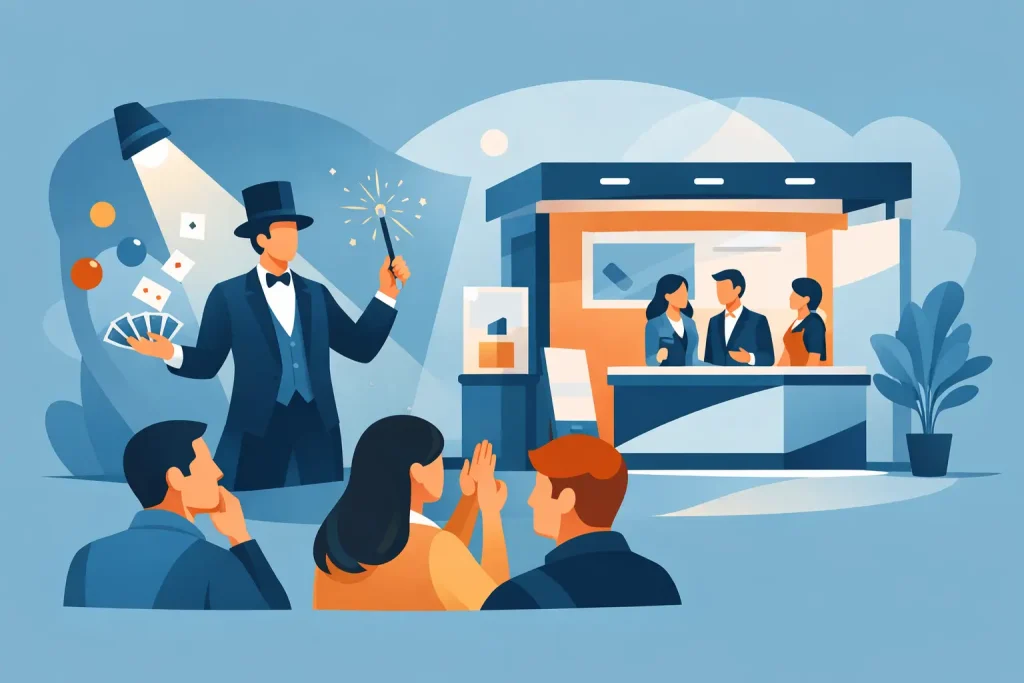
A quiet booth is expensive. You may have paid for the floor space, shipped the display, built the demo, trained the team, and sent your best people across the country – only to watch attendees stream past toward a louder, more interesting competitor. That is the real question behind is trade show entertainment worth it: can it turn attention into legitimate business opportunities?
The answer is yes, when entertainment is used as a strategic attraction rather than a random sideshow. A skilled trade show performer does not replace a strong product, a clear message, or a prepared sales team. They create the opening those elements need. They stop the right people, earn a few seconds of attention in a noisy hall, and hand your representatives a warmer conversation than they would have had with a cold passerby.
For exhibitors with meaningful goals – product launches, lead targets, demos, distributor meetings, or brand visibility – that difference can be substantial.
Is Trade Show Entertainment Worth It? It Depends on the Job
Not every performer is a fit for every booth. If the entertainment has no connection to your audience, your brand, or your sales process, it can produce a crowd that looks impressive but does little for your pipeline. Plenty of exhibitors have made that mistake: lots of applause, lots of photos, very few qualified contacts.
Trade show entertainment earns its place in the budget when it solves a specific event problem. Maybe your booth sits in a low-traffic aisle. Maybe you are launching a technical product that needs a reason for people to pause. Maybe your sales team is excellent in one-on-one conversations but struggles to get strangers to cross the aisle. Or maybe three competitors sell a similar solution within fifty feet of your display.
In those situations, live entertainment can create a competitive advantage. It gives attendees a reason to stop now, not later. And at a trade show, later often means never.
The strongest results come from performance that supports the booth’s business objective. A customized magic presentation, for example, can build your product, key benefit, or campaign message into a short, visual demonstration. The audience gets an entertaining moment. Your team gets a natural handoff. Your brand gets associated with the moment people remember from the show floor.
Attention Is the First Sale
Trade show attendees are not short on choices. They are short on time, energy, and patience. By the middle of the day, even highly interested buyers have seen similar signage, heard similar pitches, and collected more brochures than they will ever read.
A compelling performer interrupts that pattern without forcing it. People stop because they are curious. They stay because something is happening. That creates the most valuable asset on the floor: a small window of focused attention.
A good trade show magician understands the difference between gathering people and holding people. The goal is not to block the aisle with a giant crowd that cannot engage. The goal is to create repeatable pockets of interest, bring attendees into the booth, and make space for your sales team to identify the people worth speaking with.
That rhythm matters. Short, high-impact presentations run throughout the day can keep your booth active without exhausting your team or trapping attendees in a long show. The performance draws them in, delivers a memorable message, and releases them directly into a conversation with someone who knows the product.
What a Real Return Can Look Like
The return on trade show entertainment is not limited to the number of people who watch. Traffic matters, but traffic alone is a vanity metric. The better question is whether your booth receives more qualified conversations, scans, demo requests, follow-up meetings, or sales opportunities because the performer was there.
A strategic performer can improve results in several ways:
- Increase booth stops by making your space visibly active and approachable.
- Give sales representatives a simple, natural opener after the performance.
- Reinforce a product message in a format people can recall after a long day.
- Help differentiate your company when competitors offer nearly identical booth experiences.
- Create shareable moments that extend your presence beyond the people standing nearby.
The exact impact depends on your offer and your follow-up process. A company selling enterprise software may measure success in booked demos and meetings with decision-makers. A consumer brand may care more about volume, sampling, social engagement, and name recognition. A manufacturer may want distributors and buyers to spend more time with a new product line.
Entertainment should be designed around that outcome. If your internal team cannot explain what happens after an attendee stops, the performer cannot fix the whole funnel. But if you have a clear offer, a strong staff, and a way to capture information, entertainment can make the funnel move faster.
The Sales-Team Handoff Is Where Value Is Won
The best performers do not monopolize your audience. They make your sales team more effective.
Before the show, your performer should understand who you want to meet, what you want to say, and what action you want attendees to take. That might mean registering for a demo, scanning a badge, entering a giveaway, meeting a product specialist, or scheduling a post-show conversation. The message does not need to be a lengthy commercial. It needs to be clear enough that the audience understands why your company matters.
Then your booth staff needs a handoff plan. A representative should be ready when the performance ends, not buried in an email or standing behind a counter waiting to be approached. The strongest handoffs are simple: “What brought you to the show?” “Are you dealing with this issue at your company?” “Want to see how this works in two minutes?”
That is why experienced exhibitors brief their teams before opening doors. Define who handles badge scans, who gives product demonstrations, who qualifies leads, and who follows up with high-value prospects. Entertainment creates momentum. Process converts momentum into opportunities.
When Trade Show Entertainment Is Not the Right Move
There are cases where the money is better spent elsewhere. If your booth is understaffed, your offer is unclear, or your team has no method for capturing leads, fix those basics first. Drawing more people into a disorganized booth only makes the weakness more visible.
It may also be a poor fit when the event is built around scheduled, private buyer meetings rather than open-floor traffic. In that environment, hospitality, executive hosting, or a focused presentation may make more sense than an aisle-facing attraction.
The performer matters, too. A generic act can feel disconnected from a serious B2B brand. The right professional knows how to read a corporate audience, work around booth logistics, manage volume, respect neighboring exhibitors, and deliver energy without making your company look gimmicky. That combination is not incidental. It is the job.
How to Decide Before You Book
Start with the cost of being ignored. Calculate what you have invested in the show, then ask whether your current booth plan gives people a compelling reason to stop. If the honest answer is “our logo and a brochure,” you have a traffic problem before the doors even open.
Next, establish a measurable goal. Set a target for qualified conversations, lead captures, demos, or booked meetings. Compare it with your normal show performance. This keeps the decision grounded in business results rather than vague hopes that the booth will “feel busier.”
Finally, choose entertainment that fits the way your audience buys. For a fast-moving expo, short, repeatable sets may work best. For a complex solution, a presenter who can weave your core benefit into a concise demonstration may create more value. For an evening client event attached to the show, close-up magic can keep conversations lively without pulling focus from relationship building.
The point is not to add spectacle for spectacle’s sake. It is to make your booth easier to notice, easier to approach, and harder to forget.
Make the Booth the Place People Talk About
Trade shows reward exhibitors who create a clear reason to stop. A polished, customized live experience can give your brand that reason while making life easier for the people carrying the sales target.
If you are considering trade show entertainment, do not ask only whether it will draw a crowd. Ask what that crowd will hear, who will speak with them next, and what business action you want them to take. When those answers are planned before the first trick, the first laugh, or the first applause, entertainment stops being an expense and starts doing the work it was hired to do.