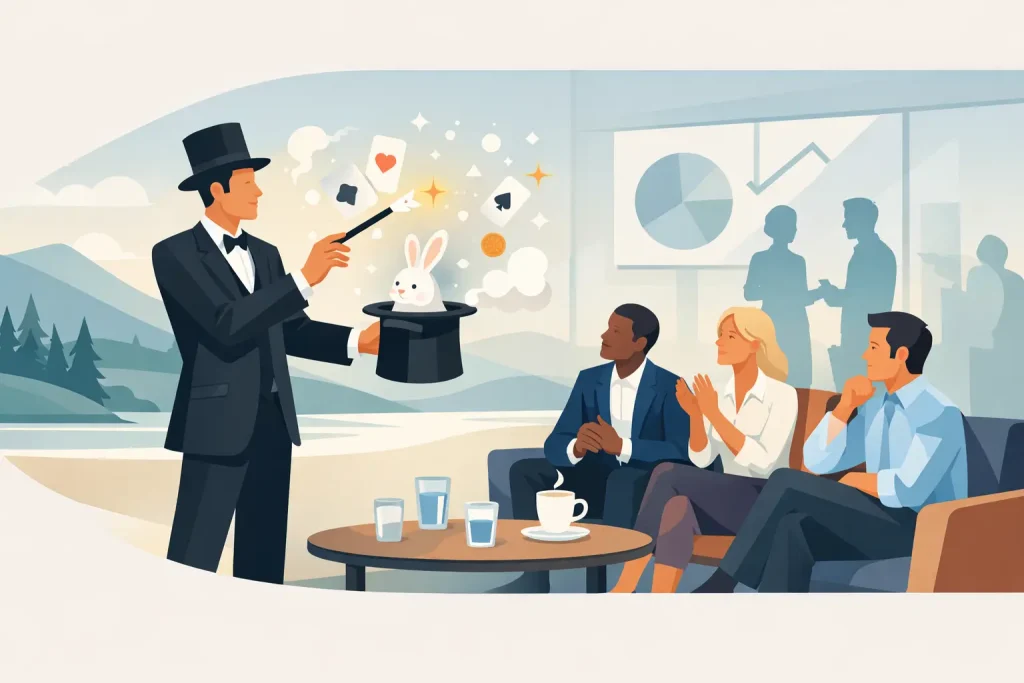
A leadership retreat can have the best venue, sharpest agenda, and most impressive dinner in town – then still feel like an extended meeting with better views. If “magician for executive retreat” is on your planning brief, you are not looking for a party trick. You are looking for a smart way to reset the room, create real conversation, and give high-level attendees an experience they will remember after the slide decks are closed.
The right corporate magician creates a shared moment of surprise without asking executives to check their professionalism at the door. That matters. Senior leaders have limited patience for forced fun, generic entertainment, and programming that feels disconnected from the purpose of the retreat. A polished performance changes the energy quickly while respecting the intelligence, time, and expectations of the people in the room.
What a Magician Brings to an Executive Retreat
Executive retreats usually ask attendees to do difficult work: make strategic decisions, have candid conversations, align competing priorities, and think beyond quarterly pressure. That work requires focus. It also requires breaks that actually refresh people instead of simply filling time.
Magic is unusually effective because it creates immediate attention. A strong performer does not need a long runway, a loud production, or a room full of volunteers eager to be put on the spot. The experience begins in the hands of a few guests, spreads through conversation, and gives the group something genuinely unexpected to react to together.
That reaction is more valuable than it sounds. When leaders are surprised, they become present. When they laugh together, hierarchy softens for a moment. When they debate how something happened, they are talking to people outside their usual work lane. Those small interactions can make a reception, dinner, or transition period feel intentional rather than obligatory.
The goal is not to distract from the retreat. It is to protect the human energy that makes the retreat productive.
A Magician for an Executive Retreat Is Not One-Size-Fits-All
The most successful entertainment format depends on your agenda, group size, and the role the retreat needs the experience to play. An intimate leadership offsite of 20 people needs something different from a 250-person national sales leadership summit.
Close-up magic for dinners and receptions
Close-up magic works especially well during cocktail receptions, welcome dinners, and hospitality events. The magician moves naturally among small groups, performing impossible moments inches from guests. Nobody has to stop networking. Nobody has to sit through another presentation. Conversations simply become more animated.
This is often the right choice when attendees are arriving from different offices or business units and need an easy, low-pressure way to connect. Instead of standing with the people they already know, guests have a reason to gather, react, and introduce themselves.
A featured performance to reset the room
For a larger retreat or an agenda with a clear evening program, a headline-style corporate magic show can create a memorable centerpiece. This format works after dinner, before an awards moment, or at the point when the room needs a deliberate lift.
The best corporate shows are interactive without becoming uncomfortable. Executives can participate, but they are never treated as the punchline. The tone should be smart, fast-moving, and appropriate for the culture of the company. A room of financial leaders may want a different level of energy than a creative leadership team. A seasoned corporate performer reads that difference before stepping onstage.
Emceeing that keeps momentum alive
Sometimes the entertainment challenge is not a single time slot. It is the entire flow of the event. If the retreat includes presentations, leadership panels, awards, and multiple transitions, an emcee with magic skills can keep the program from losing steam between segments.
This approach is practical. The performer can introduce speakers, recover from schedule changes, recognize teams, and use short moments of interactive magic to hold attention while the room resets. It turns dead air into part of the experience.
The Business Case Is Stronger Than “It Will Be Fun”
Fun is not a weak outcome, but it should not be the only reason to book entertainment for a leadership event. The better question is: what does this experience help the event accomplish?
A magician can help establish a warmer tone at the start of a retreat, particularly when attendees do not know one another well. At a multi-day program, magic can break up information-heavy sessions and help prevent the familiar afternoon drop in attention. At an evening event, it gives the group a standout experience that feels more considered than a DJ in the corner or another open bar.
It also supports memorability. People forget much of what is said at a retreat, even when the content is valuable. They remember how the event felt. They remember the moment their colleague’s signed card appeared in an impossible location. They remember the room erupting in laughter after a leadership team member participates in a feature routine. Those moments become part of the story attendees tell when they return to work.
That does not mean magic replaces meaningful strategy, strong facilitation, or a well-designed agenda. It amplifies them. If the retreat itself lacks clarity, no performer can manufacture alignment. But when the core program is solid, the right entertainment makes the experience feel more alive and more worth attending.
What to Look for Before You Book
Corporate planners are right to be selective. A talented magician is not automatically an effective executive-event partner. The setting calls for more than technical skill.
Look for a performer who understands business audiences and asks questions about your event before recommending a format. They should want to know who is attending, what the retreat is designed to achieve, where entertainment fits in the schedule, and what the room setup allows. A performer who immediately sells a standard package without discussing those details may be treating your retreat like every other event.
Professionalism matters just as much. Your entertainer should be comfortable with executive assistants, venue teams, AV staff, and last-minute changes. They need to arrive prepared, communicate clearly, dress for the occasion, and work within the event’s timing. The goal is to make you look organized, not add one more vendor to manage.
You should also be clear about tone. Ask whether the performance can be clean, sophisticated, and customized to your company culture. For some groups, that means polished and understated. For others, it means high-energy and playful. Both can work. The wrong fit is entertainment that feels like it was dropped into the room from a different event.
Timing Can Make or Break the Experience
A common mistake is booking a great performer and placing them in the wrong part of the agenda. Magic is most effective when it solves an actual energy or connection problem.
For welcome receptions, strolling magic gives early arrivals something to enjoy and encourages mingling before dinner. For a full-day strategy session, a short feature performance after lunch can reset attention before the afternoon agenda. For an awards dinner or closing night, a larger show gives the group a high-impact shared finale.
Avoid squeezing entertainment into a rushed five-minute gap or placing it after attendees have mentally checked out for the evening. Give the experience enough space to land. Even close-up magic benefits from a clear window where guests are able to relax, socialize, and be present.
Venue conditions matter, too. Loud cocktail rooms favor visual, high-impact close-up effects. A banquet room with proper sound and sightlines supports a featured show. If your retreat is in Las Vegas, Orlando, Nashville, Chicago, or New York City, an experienced corporate entertainer can also help you think through the practical realities of hotel ballrooms, private dining rooms, and convention spaces.
Make the Entertainment Feel Like Part of the Retreat
The strongest executive events do not treat entertainment as an isolated add-on. They use it to reinforce the feeling they want attendees to carry through the program: curiosity, collaboration, celebration, or confidence in the road ahead.
That can be as simple as choosing a performance style that matches the occasion. It can also include a brief custom reference to a company theme, a leadership message, or a milestone worth recognizing. The key is restraint. A little tailored relevance makes the experience feel personal. Too much branding can make it feel like another presentation in disguise.
Mike Seege approaches corporate magic with that balance in mind: big audience response, polished execution, and an understanding that the event is ultimately about your people and your business objectives. The magic creates the moment. Your retreat gives that moment meaning.
When you are building an executive retreat, do not settle for a schedule that merely keeps people occupied. Create one unexpected point of connection that gets leaders off autopilot, brings the room together, and gives them a reason to keep talking long after the retreat ends.