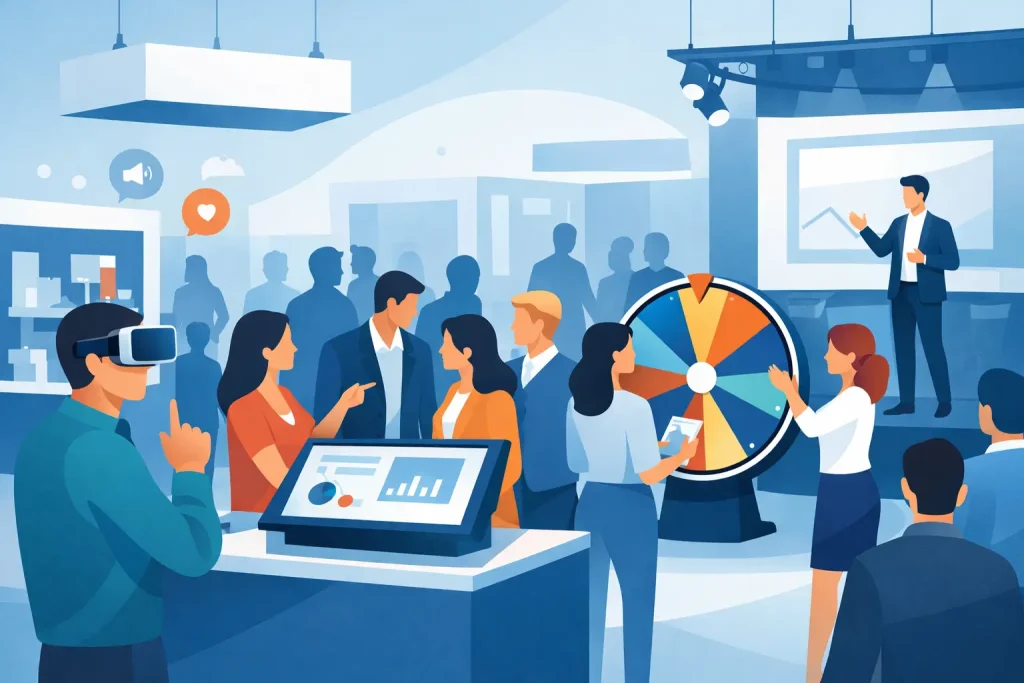
A trade show floor does not reward the booth with the most brochures. It rewards the booth that gives busy attendees a reason to stop, participate, and remember who started the conversation. The most valuable trade show engagement trends are moving exhibitors away from passive displays and toward live, human experiences that create real sales opportunities.
For marketing teams and event planners, that shift matters. You are not simply trying to look busy. You need the right people gathered around your booth, a clear brand message landing in their minds, and your sales team introduced at the moment interest is highest. That takes more than a giveaway bowl and a hopeful smile.
Trade Show Engagement Trends Are Becoming More Human
After years of digital outreach, automation, and screen fatigue, attendees are responding to experiences that feel immediate and personal. They want a break from scanning banners, checking email, and hearing another product pitch. They want a moment worth talking about.
That does not mean business events have become less serious. It means the attention economy on the show floor has become more demanding. A branded experience must entertain quickly, but it also has to create a useful opening for a business conversation.
Live performance is increasingly part of that equation. A skilled trade show entertainer can stop traffic, hold a crowd, and turn product points into a memorable demonstration. When a customized effect reinforces a company message, the entertainment is not separate from the selling. It becomes the reason attendees remember what the company does and why it matters.
The key is relevance. Random entertainment can attract a crowd that leaves as quickly as it arrived. A purposeful live presentation attracts attention, delivers a message, and gives the sales team a natural handoff. That is the difference between applause and qualified leads.
Micro-experiences are replacing long booth presentations
Trade show attendees manage their time in short bursts. They may have 30 seconds to notice a booth, three minutes to engage, and only a few more minutes before their next appointment. Long, static product demonstrations can work for a highly technical audience, but they often struggle to earn initial attention in a noisy aisle.
The stronger approach is a repeatable micro-experience. Think of a short, high-impact presentation that can start often, build a crowd, and communicate one clear idea. It might reveal a product benefit, frame a customer problem, or make a brand promise impossible to miss.
This format respects the attendee’s schedule while giving exhibitors multiple chances to draw fresh traffic throughout the day. It also keeps booth energy from disappearing after the morning rush.
Engagement Must Create a Sales Conversation
The best booth experiences are designed backward from the sales conversation. Before selecting a game, giveaway, performer, or interactive demo, ask one direct question: What should the attendee do immediately after engaging?
If the answer is vague, the experience may be fun but difficult to measure. If the answer is meet a product specialist, book a demo, answer a qualifying question, or scan a badge for a specific resource, the activation has a job to do.
This is where sales teams need to be involved early. They know the questions that separate casual visitors from serious prospects. They know what objections appear most often and which product benefits move a conversation forward. Build those insights into the booth experience rather than expecting the sales team to recover the interaction afterward.
A customized magic presentation, for example, can introduce a key challenge facing the audience, visually demonstrate the solution, and invite an attendee to participate. Once the effect lands, a booth representative steps in with a relevant next question. The transition feels earned because the prospect is already engaged.
The handoff matters as much as the crowd
A large audience is a good start, not the finish line. Some exhibitors make the mistake of celebrating traffic without assigning a clear process for capturing it. The result is a packed booth, a tired team, and a lead report full of names with little context.
Set roles before the show opens. The performer or presenter draws and holds attention. One team member welcomes people at the edge of the crowd. Another identifies strong prospects and begins the deeper conversation. A third manages badge scans, demos, or meeting scheduling. At a smaller booth, one person may handle more than one role, but the sequence should still be clear.
Keep the first sales question simple. Asking what brought someone to the show, what challenge they are trying to solve, or whether they are evaluating a particular category is more effective than launching into a full pitch. Attendees should feel invited, not trapped.
Participation Is More Valuable Than Passive Watching
People remember what they help create. That is why attendee participation is one of the most durable trade show engagement trends. A volunteer who joins a quick demonstration, influences an outcome, answers a prompt, or sees their own choice incorporated into the experience has a reason to stay mentally present.
Participation also creates social proof. When one visitor is laughing, reacting, or taking part, nearby attendees see that something is happening. Curiosity does the rest. A booth that looks alive pulls better than a booth with perfect graphics and no visible activity.
There is a trade-off. Participation must be fast, comfortable, and optional. No one wants to be embarrassed in front of colleagues or forced into a high-pressure game just to receive a giveaway. The best interactions make the attendee look good while making the brand message clearer.
For highly technical products, participation may mean choosing between common industry challenges or seeing a familiar process transformed in a surprising way. For a consumer-facing brand, it may be more visual and playful. The format depends on the audience, but the principle stays the same: give people an active role, then connect that moment to a useful business idea.
The Booth Is Becoming a Content Engine
A good live moment now has value beyond the aisle. Attendees take photos, record quick clips, text colleagues, and return with other decision-makers when they see something worth sharing. That does not mean every activation needs a giant neon backdrop or a viral stunt. It means the experience should be visually clear and easy to describe.
Could someone explain what happened in one sentence? Could a short video show genuine audience reaction without needing a lot of context? Would a customer recognize the brand message from the moment alone? Those are practical tests of whether an experience has shareable energy.
Branding should support the experience, not bury it. Too much visual clutter weakens the focal point. Put the central message where the crowd can see it, keep the call to action obvious, and let the activity create the motion. When the booth is full, passersby should quickly understand both what is happening and who is behind it.
Data Is Useful Only When It Improves Follow-Up
Badge scans remain valuable, but a scan is not a relationship. Strong exhibitors are pairing live engagement with better context: which presentation did the attendee watch, what problem did they mention, what product category interested them, and did they request a follow-up conversation?
Do not ask staff to collect every possible detail while the booth is busy. That slows the experience and makes the interaction feel transactional. Instead, identify the two or three pieces of information that will help sales prioritize outreach. The rest can come later.
Speed matters after the show. A warm lead is warm because the experience is still fresh. Follow-up should reference the conversation or moment at the booth, not read like a generic post-event email. If a prospect participated in a branded presentation, saw a particular product demo, or asked about a specific challenge, that is the opening for the next conversation.
Build Energy Into the Full Show Schedule
Booth engagement is not an all-day setting. It rises and falls with keynote schedules, lunch, happy hours, competing presentations, and plain old attendee fatigue. The most effective teams plan for those changes instead of hoping enthusiasm lasts from open to close.
Schedule repeated attraction moments during predictable slow periods. Use a high-energy presentation to restart traffic after lunch. Give the sales team a chance to reset between peak windows. If your booth is near a major session exit, be ready with a fast, visual reason for people to pause before they move on.
This is also why professionalism matters. A live attraction has to work within show rules, sound limits, booth footprints, and a sales team’s workflow. Mike Seege approaches trade show magic as a business tool because the goal is not simply to entertain a crowd. The goal is to create a polished, repeatable audience moment that supports the people responsible for converting interest into revenue.
The strongest booth strategy is not the loudest one. It is the one that makes the right attendee stop, gives them a reason to care, and puts the right salesperson in front of them while the energy is still high. Plan that moment before the exhibit hall opens, and your booth has a much better chance of being the one people talk about after the badges come off.