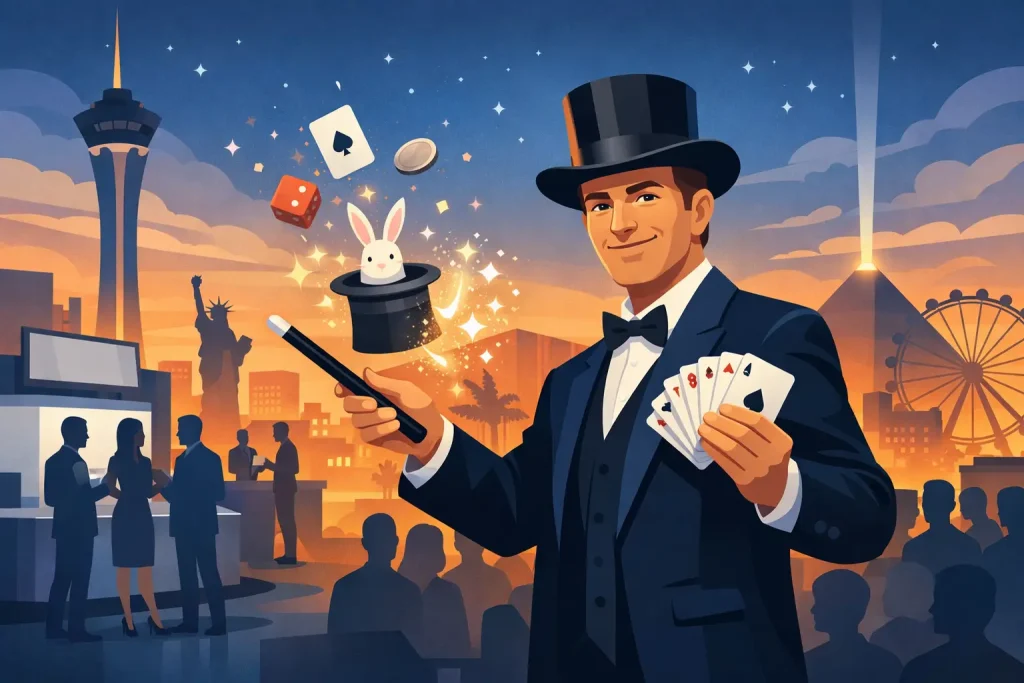
A Las Vegas trade show floor gives attendees hundreds of reasons to keep walking. Your booth gets seconds to earn a pause, and a logo wall or bowl of candy will not do it. Trade show magician Mike Seege Las Vegas gives exhibitors a smarter way to stop traffic, hold attention, communicate a message, and introduce salespeople to prospects who are already engaged.
This is not magic placed beside a business objective. It is a live, customized presentation built around the objective. The right performance turns a crowded aisle into a gathering, a product message into a moment people repeat, and a cold introduction into a warmer sales conversation.
Why Trade Show Floors Need More Than a Crowd
Getting a big crowd is useful only if it creates room for the right conversations. At a major Las Vegas convention, attendees have packed schedules, noisy surroundings, and more booths competing for attention than they can possibly visit. The challenge is not simply being seen. It is being worth stopping for.
A professional trade show magician creates that first break in the pattern. People see a surprising visual moment, hear laughter, and notice a crowd forming. Curiosity does the initial work. Then the presentation directs that attention toward your company, your product, and the reason a prospect should speak with your team.
That distinction matters. A generic act can produce applause and disappear from memory by the next aisle. A strategic performance gives attendees a reason to remember what your company does. The magic creates the hook. Your message gives it business value.
How Mike Seege Uses Magic to Support Your Booth Goals
A customized trade show program begins with the question every exhibitor should ask: what needs to happen at this event? For some teams, the priority is booth traffic. For others, it is a product launch, appointment setting, lead capture, or getting a difficult technical story across in plain language.
Mike Seege builds the presentation around that target. Product benefits, differentiators, campaign language, and call-to-action points can be incorporated into short, repeatable demonstrations designed for a busy show floor. The result feels entertaining because it is entertaining. It also gives your sales team a natural, credible bridge into the next conversation.
A strong trade show performance often follows a simple rhythm. A visual effect catches attention from the aisle. The audience gathers for a brief, high-energy routine. The routine lands on a branded point, then a sales representative steps in while interest is high. That handoff is where entertainment becomes an exhibit strategy.
The presentation can be performed as a scheduled mini-show, repeated at regular intervals throughout the day, or delivered in a more mobile style depending on your booth layout and staffing plan. It depends on your floor space, the complexity of the message, and whether your sales team needs a large audience or smaller, more personal interactions.
Trade Show Magician Mike Seege Las Vegas for High-Stakes Events
Las Vegas is built for spectacle, which can make exhibiting there both exciting and demanding. Attendees arrive expecting polished experiences. Event planners and marketing teams need partners who understand the pace of a large convention, show up prepared, and can perform under real-world booth conditions.
That means working around noise, narrow sightlines, tight schedules, product demos, neighboring exhibitors, and the constant movement of attendees. A trade show magician must know how to build a crowd without blocking an aisle, keep a presentation moving without dragging people away from meetings, and adapt when the floor energy changes.
The best performance is never an interruption to your exhibit plan. It is an engine for it. Before doors open, the details should be clear: where the presentations happen, how often they run, what message must be included, who receives the lead handoff, and how the team captures prospect information. Preparation protects the experience and helps your staff make the most of every crowd.
What Makes a Booth Presentation Worth the Budget
Corporate buyers should be careful about measuring live entertainment by applause alone. Applause is great. It is not the finish line.
A worthwhile trade show program should help create visible outcomes: more people stopping at the booth, a stronger volume of qualified conversations, a message attendees can recall later, and a sales team that is not left trying to start every interaction from scratch. The value grows when the performer and the booth team work as one unit.
There are trade-offs. A large, highly visual presentation may pull a bigger crowd, but it requires enough space and a team ready to engage people immediately afterward. Close-up magic can work beautifully in a smaller footprint or hospitality setting, but it may not deliver the same dramatic aisle draw. Scheduled presentations give your team predictable traffic surges. Roving engagement offers flexibility when attendee flow is unpredictable.
The right choice depends on how your exhibit functions. A product with a quick, clear benefit may be ideal for frequent short demonstrations. A complex service or enterprise solution may benefit from the initial crowd-building power of magic followed by a more deliberate consultation with a subject matter expert.
Give Your Sales Team a Better Opening Line
Trade show staff often face the hardest part of the sales process dozens of times each day: earning permission to begin. A well-timed performance changes the emotional temperature of that interaction. Instead of opening with a cold question as someone hurries past, your representative meets a prospect who has just shared a surprising, memorable experience.
That does not eliminate the need for a trained team. It makes that team more effective. Salespeople still need a clear qualifying question, a plan for capturing lead details, and an offer that moves the conversation forward. What they gain is a better opening and a more receptive audience.
The handoff should be intentional. Before the event, decide which team members will approach guests, what they will say, and what counts as a qualified lead. If the goal is booked demos, make the next step easy to schedule. If the goal is product education, have a specialist ready. If the goal is brand awareness, give attendees a message worth repeating after they leave the booth.
Planning for a Performance That Delivers
A high-impact trade show activation does not need to be complicated, but it does need ownership. Marketing, sales, booth operations, and the performer should agree on the central message and the practical flow of the experience.
Start with the single idea you want attendees to remember. Trying to force every feature, statistic, and campaign phrase into a short presentation weakens the result. One strong promise, supported by a memorable visual moment, lands harder than a crowded script.
Next, plan the post-performance experience. Where will interested guests go? Who greets them? How will leads be captured? What happens when a crowd is larger than expected? These questions are not glamorous, but they are often the difference between a fun booth and a productive one.
Finally, give the program enough repetition to create momentum. One performance can create a moment. Multiple well-timed presentations can make your booth feel active throughout the day, particularly during peak traffic windows. Your show schedule should support your team’s energy rather than overwhelm it.
Your next Las Vegas exhibit does not need more noise. It needs a reason for the right people to stop, stay, and start a conversation. Build that reason into the booth experience, prepare your team for the handoff, and make every gathered crowd count.