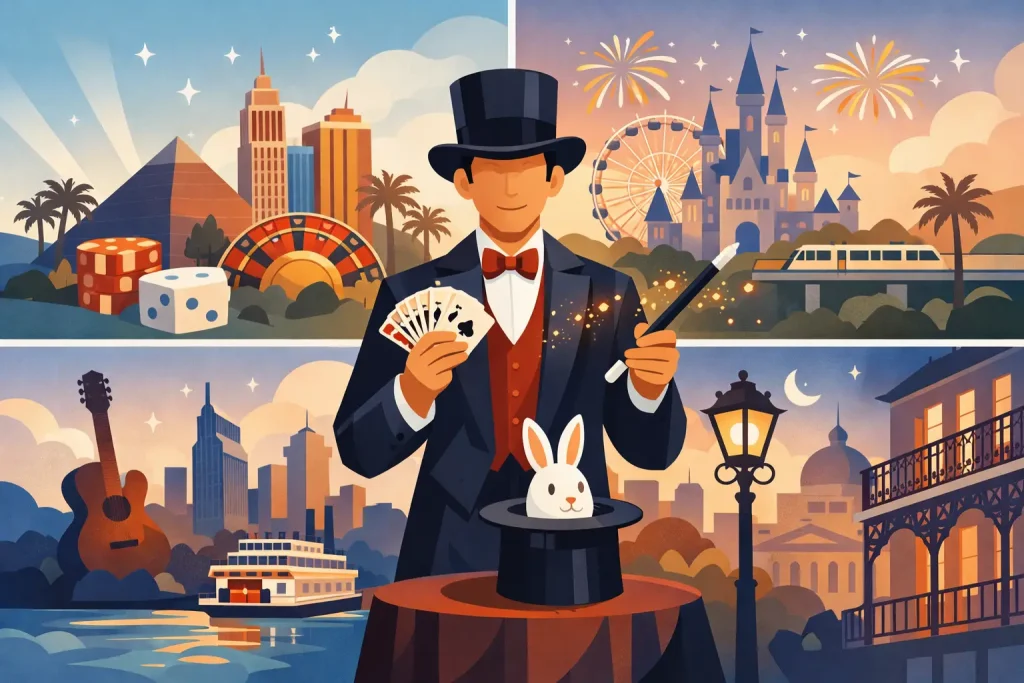
A crowded exhibit floor does not reward the booth with the prettiest backdrop. It rewards the booth that gives attendees a reason to stop. A trade show magician in Las Vegas, Orlando, Nashville, or New Orleans can create that reason in seconds, then turn a passing glance into a real sales conversation.
That distinction matters. Trade show entertainment should not be a distraction from the business objective. It should be the engine that starts the interaction: a visual moment that gathers a crowd, a branded routine that earns attention, and a smooth handoff that puts your sales team in front of interested prospects.
What a Trade Show Magician Actually Does
At a corporate expo, every exhibitor is competing with noise, giveaways, competing demos, and attendees who are already being pulled in ten directions. A skilled trade show magician changes the traffic pattern around your booth. The performance creates a natural crowd, gives people permission to pause, and makes your brand feel like the most active destination on the floor.
But the strongest results come from more than impressive magic. The presentation needs to be built around your company, your product, and the action you want attendees to take. That may mean a product reveal, a key benefit woven into a routine, a quick qualification question, or an invitation to schedule a demo.
The result is not simply applause. It is a booth team speaking with people who are already engaged.
The handoff is where the ROI lives
A great crowd is valuable only when your team can work it. That is why timing and coordination matter. After a short, high-impact performance, the magician directs interested attendees to a sales representative, product expert, or lead-capture station while attention is still high.
Your team should not have to interrupt the show or awkwardly chase people as they walk away. The transition should feel intentional: “If you want to see how that principle works in the real world, this is the person you need to meet.” That simple moment turns entertainment into a conversation starter with a business purpose.
Trade Show Magician in Las Vegas, Orlando, Nashville, and New Orleans
These cities host high-stakes events for a reason. Las Vegas brings together massive conventions, competitive exhibit halls, and buyers who have seen every kind of spectacle. Orlando is built for national association meetings, technology conferences, and corporate gatherings where schedule pressure is real. Nashville blends business events with a strong expectation of personality and hospitality. New Orleans gives planners an audience that responds to energy, participation, and memorable experiences.
The common challenge is not the venue. It is standing out without creating chaos at your booth.
A polished performer understands the rhythm of an exhibit floor. The show has to be visible enough to attract attention, compact enough to repeat throughout the day, and flexible enough to work around aisle traffic, sound limits, nearby exhibitors, and changing crowd sizes. In a large Las Vegas hall, that might mean short, repeatable crowd-building sets timed around peak traffic. At an Orlando conference, it may mean pairing a branded presentation with scheduled product demos. In Nashville or New Orleans, the right approach may lean more heavily into direct interaction and hospitality-suite entertainment after the floor closes.
The city sets the backdrop. Your goals determine the show.
Build the Show Around a Clear Booth Objective
Before booking any attraction, decide what success looks like. “More traffic” is a start, but it is not enough. Are you launching a product? Trying to get decision-makers into a demo? Reintroducing a brand after a repositioning? Building a list for post-show follow-up?
A trade show magician can support each of those goals differently.
For a product launch, the magic can create anticipation before the reveal and make the product the final focus of the routine. For lead generation, the performance can invite attendees to answer a quick qualifying question or scan a badge to receive an exclusive follow-up. For a complex service, the show can simplify a big idea into a memorable visual metaphor that your reps expand on in conversation.
The trade-off is simple: the more tightly customized the performance is, the more planning it requires. A generic act may entertain, but it will not carry your message with the same precision. For a major show where booth space, travel, staffing, and sponsorship already represent a significant investment, customization is often the smarter move.
Keep the message short enough to remember
No attendee wants to be trapped in a five-minute commercial. The branded message should be sharp, visual, and easy to repeat. Think one central promise, one memorable demonstration, and one next step.
If your team cannot explain the takeaway in a single sentence, the script probably needs work. The goal is to create curiosity, not deliver the entire sales deck from a stage surrounded by strangers.
Make the Performance Easy for Your Sales Team to Use
The best entertainment partner does not arrive with a show and ask your team to figure out the rest. They work backward from the sales process.
That starts with a practical pre-show conversation. Share the product, audience profile, ideal customer, key talking points, booth layout, and lead-capture process. Explain what happens after an attendee stops. Are reps scheduling consultations? Demonstrating software? Giving tours? Offering a premium giveaway? The performance should support that path, not compete with it.
Your booth staff also needs a simple plan. They should know where to stand during the show, when to approach attendees, what opening question to use, and how to record useful notes. A crowd without a staffing strategy can become a missed opportunity. A crowd with a confident, prepared team becomes a pipeline.
Mike Seege approaches trade show magic as a business tool, not background amusement. That means crowd-building performance, customized messaging, and an organized handoff designed to help sales teams meet people who are ready to talk.
Choose the Right Format for the Floor
There is no single format that fits every exhibit. The best choice depends on your booth footprint, traffic flow, event rules, and sales process.
A scheduled mini-show works well when you have enough open space to gather people and want to create predictable bursts of energy. It gives attendees a reason to return at a certain time and helps your staff prepare for concentrated conversations.
Strolling or close-up magic is often better for a smaller footprint, a hospitality lounge, or a booth where blocking the aisle would be a problem. It creates one-on-one engagement and can move naturally between small groups without requiring a formal crowd.
A hybrid approach can be especially effective at larger shows: short headline moments to create visibility, followed by close-up interaction that keeps people engaged while reps continue conversations. It depends on staffing. If your team is lean, avoid generating a crowd that no one is available to greet. If you have a full sales crew, high-energy mini-shows can create a powerful rhythm all day.
Measure More Than Applause
Applause is a good sign. It is not the metric that justifies the investment.
Set realistic measurements before the doors open. Compare booth traffic during performance windows with non-performance periods. Track badge scans, qualified conversations, demos booked, follow-up appointments, and the number of attendees who mention the performance when they return. Ask your sales team whether the entertainment made introductions easier and whether prospects arrived with better questions.
Not every lead will close on the show floor. That is normal, especially for longer B2B sales cycles. The value may show up later in higher-quality follow-up conversations and stronger brand recall. When a prospect is sorting through dozens of vendors after the event, being the company that created the memorable, relevant moment can give your team a valuable advantage.
Avoid the Common Booth Entertainment Mistakes
The biggest mistake is booking entertainment as an afterthought. If the performer is brought in the week before the event with no product knowledge, no lead process, and no staff coordination, the outcome will likely be a pleasant show rather than a sales asset.
Another mistake is overloading the routine with corporate language. Your message should be present, but the audience still needs to enjoy the experience. Too much explanation drains the energy that drew people in.
Finally, do not ignore the physical realities of the venue. Confirm performance space, ceiling restrictions, sound rules, electrical needs, show hours, union requirements when applicable, and the location of your lead-capture team. Professional event execution is often won in these details.
A busy floor gives you only a few seconds to earn attention. Use them to create a moment people want to see, a message they can remember, and an introduction your sales team can turn into something bigger.