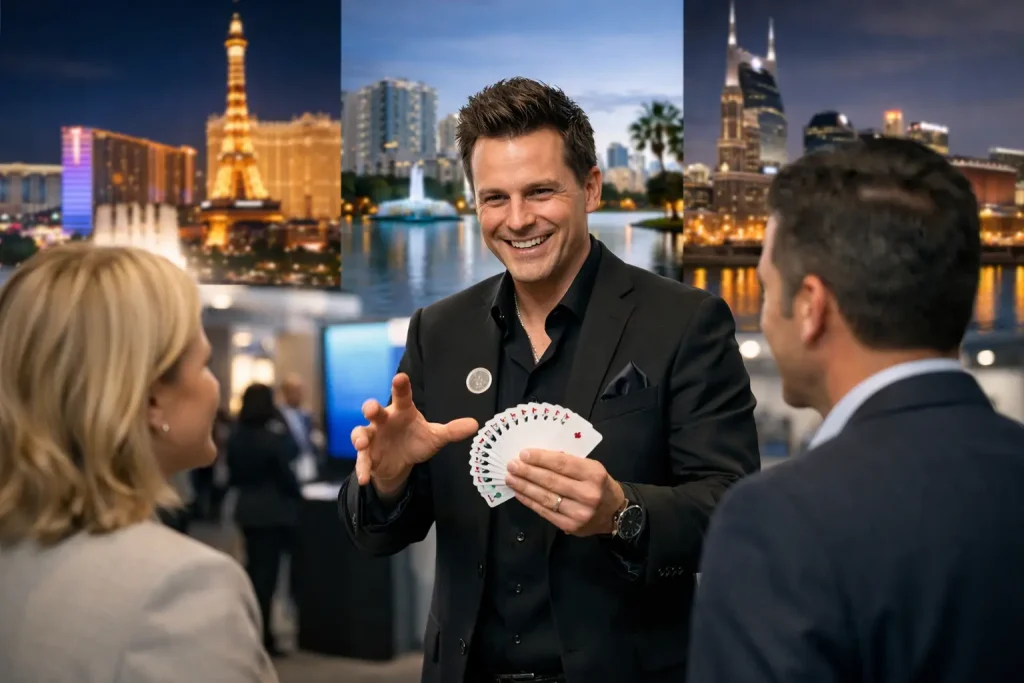
The search phrase trade show magician las vegas orlando nashville points to a familiar problem for exhibitors: you have a great product, a costly booth, and only a few seconds to earn a stranger’s attention. In a packed exhibit hall, “stop by if you’re interested” is not a strategy. You need a reason for people to stop, stay, and start a conversation with your team.
A skilled trade show magician does more than draw a crowd. The right performer creates a visible moment of curiosity, gathers qualified prospects around a clear message, and gives your salespeople a natural opening. That is the difference between entertainment that happens near your booth and a live experience built to support the business goals behind it.
Why a Trade Show Magician Changes Booth Traffic
Trade show attendees are moving fast. They are scanning signage, checking schedules, taking calls, and trying to decide which booths deserve their limited time. Even an outstanding product demonstration can get ignored if nobody pauses long enough to see it.
Magic creates the pause. A compelling visual moment gives attendees social permission to stop. As people gather, the booth becomes more noticeable from the aisle. That crowd attracts the next group, and suddenly your exhibit has something many booths do not: momentum.
But traffic alone is not the win. A crowd that watches, applauds, and walks away without speaking to your team is a missed opportunity. A business-focused performer manages the handoff. He can build in a branded question, introduce a product benefit, or direct guests toward a consultation, demo station, giveaway, or lead-capture process.
The result is a warmer conversation. Your team is no longer interrupting attendees in the aisle. They are meeting people who have already chosen to engage.
The Best Trade Show Magic Supports a Sales Process
A trade show performance should never force a brand message into a trick just because customization sounds impressive. The strongest programs use the product, audience, and campaign goal in a way that feels natural.
For a software company, the presentation may emphasize speed, accuracy, or solving a frustrating business problem. For a manufacturer, it may reinforce precision, reliability, or the surprise of seeing what is possible. For a healthcare, finance, or technology brand, the approach may be more polished and conversational, with the message woven into a short demonstration rather than pushed like a commercial.
Before the show, the performer should understand three things: who you need to reach, what you want them to remember, and what your team wants them to do next. Those answers shape everything from the style of interaction to the timing of the sales handoff.
A good trade show magician also respects the reality of the exhibit floor. The performance needs to work around noise, neighboring booths, open aisles, rotating staff schedules, and attendees who may only have five minutes. Short, repeatable sets often outperform a single long show because they create multiple opportunities for new prospects to join throughout the day.
Trade Show Magician Las Vegas, Orlando, or Nashville: What Changes?
Las Vegas, Orlando, and Nashville all host major conventions, but the show environment can feel very different. The best booking choice depends less on the city itself and more on the venue, audience, show schedule, and the kind of attention your booth needs to earn.
Las Vegas: Big Floors and High Competition
Las Vegas convention traffic can be relentless. Exhibitors are competing with enormous displays, celebrity appearances, elaborate product launches, and a city built around spectacle. A performer must be able to create a crowd quickly without becoming a distraction from your actual sales objective.
For a large Las Vegas floor, consider a hybrid approach: short scheduled feature moments that pull people in from the aisle, followed by close-up interaction that keeps the energy active between presentations. Your team needs a simple plan for identifying priority prospects and taking over the conversation while interest is high.
Orlando: Convention Energy With Packed Schedules
Orlando shows often bring together large national audiences, association attendees, and corporate teams moving between education sessions and the exhibit hall. Timing matters. A performance that runs at the right intervals can turn a slower traffic window into a productive lead-generation period.
Here, the strongest strategy is often a consistent rhythm. Create lively booth moments during breaks, then use more personal close-up magic when the floor is less crowded. The goal is not to shout louder than the room. It is to give busy attendees an experience memorable enough to make your brand part of their post-show conversation.
Nashville: Relationship-Driven Engagement
Nashville events can have a more conversational, hospitality-forward atmosphere, particularly for conferences built around networking, partnerships, or client relationships. The most effective magic may be less about a large spectacle and more about creating personal moments that make introductions easier.
This is where strolling magic, hospitality-suite entertainment, and smaller booth interactions can be especially valuable. A guest who feels included is more likely to stay, talk, and remember the people behind the brand.
Choose the Right Performance Format for Your Booth
Not every booth needs the same type of entertainment. The right format depends on your footprint, staffing, sales cycle, and available space.
A larger exhibit with room for attendees to gather may benefit from scheduled branded presentations. These mini-shows create anticipation, make it easier to direct traffic, and give your team clear moments to invite prospects into a demo or meeting.
A smaller booth may be better served by close-up magic performed right at the edge of the aisle. This approach is flexible, personal, and highly effective when you want the performer to move between clusters of attendees rather than hold a fixed audience.
For hospitality suites, client receptions, and after-hours events, strolling magic provides a different kind of value. It breaks the ice between people who have not met, keeps conversations moving, and gives guests a polished experience without stopping the event for a formal show.
There is a trade-off. A bigger presentation can create greater visibility, but it requires enough space and a team ready to handle the crowd. Close-up magic is easier to deploy in tight quarters, but it reaches smaller groups at one time. The best plan may combine both.
How to Turn Attention Into Qualified Leads
Entertainment creates the opening. Your process determines whether that opening becomes revenue.
Start by assigning a clear role to each booth team member. One person can welcome people into the performance area, another can identify decision-makers, and another can handle scans, demos, or appointment scheduling. Do not expect your sales team to improvise the handoff during a busy show day.
Give the performer a concise, useful briefing. Share your target audience, the key message, common objections, desired call to action, and any language that should be avoided. A few sharp talking points are more valuable than a long slide deck full of product details.
Decide what counts as a successful interaction before the show opens. Is the goal badge scans, demo appointments, product trials, conversations with a certain buyer title, or invitations to an evening event? If everyone knows the target, the performer can help direct traffic toward it without making the experience feel transactional.
Finally, plan the follow-up before the first attendee arrives. The excitement of the booth will fade. The impression of a remarkable interaction can last, but only if your sales team follows through while the memory is still fresh.
What to Look for Before You Book
A corporate trade show magician should be more than technically impressive. Look for someone who understands exhibit logistics, can work professionally with sales teams, and can adjust to changing conditions without creating extra work for your event manager.
Ask how the performer handles branded messaging, crowd flow, and lead handoffs. Discuss sound limitations, booth dimensions, presentation frequency, and what happens when the floor is unexpectedly quiet or overwhelmingly busy. The answers reveal whether you are hiring an entertainer for a moment or a strategic partner for the event.
Mike Seege brings that business-first mindset to corporate trade shows, using audience interaction to make booths more magnetic and sales conversations easier to start.
Your booth does not need more noise. It needs a reason for the right people to stop. Build that reason around a clear message, a prepared sales team, and an experience attendees will still be talking about after they leave the exhibit hall.